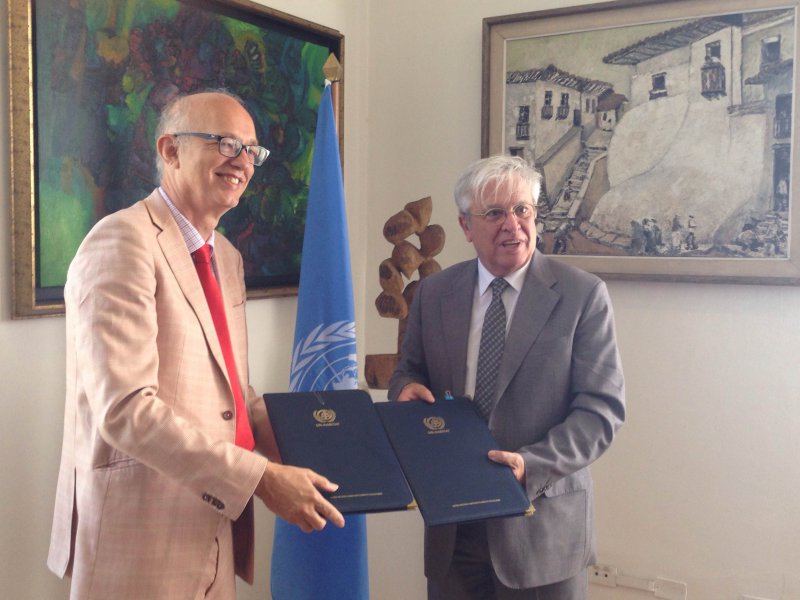
[October 19, 2016] On the final day of the Habitat III conference in Quito, Ecuador, Joan Clos, Secretary General of the United Nations Human Settlement Programme (UN-Habitat) and Cornie Huizenga, Secretary General of the SLoCaT Partnership, signed a memorandum of understanding (MoU) to accelerate action and track progress on transport-relevant components of the New Urban Agenda, the Habitat III outcome document. Transport-relevant components of the NUA include transport infrastructure/services; rural-urban linkages/food security; travel demand management; road safety; climate change/air quality/energy efficiency; freight transport; land use/transport planning; poverty/equity/inclusion; capacity building; and transport financing.
The collaboration will have a particular focus on tracking transport-relevant components of the NUA in developing and emerging economies, and will aim to bridge discussions on climate change and sustainable development through tracking implementation of sustainable urban mobility measures to reduce global carbon emissions, while achieving development imperatives such as improving air quality and road safety, and promoting accessibility and equity in urban transport systems.
The partnership will also help to encourage cooperation with ongoing tracking efforts in other global processes, including the 2030 SDGs, the Paris Agreement on climate change; the Habitat III Conference, the Addis Ababa Action Agenda, the United Nations Conference on Trade and Development process, the United Nations Global Decade of Action on Road Safety, and the Sendai Framework on Disaster Risk Reduction.
The collaboration is intended to increase UN Habitat’s capacity to follow up on the transport related provisions in the NUA by linking SLoCaT’s network with UN Habitat’s mandate; to underscore the importance of the NUA to the SLoCaT membership; and to send a strong message on the readiness of the transport sector and UN Habitat to tackle the implementation of transport in the NUA. In the short term, the partnership will help to prepare for the UN High Level Political Forum (HLPF) review of SDG Goal 11 (“Make cities inclusive, safe, resilient, and sustainable”) in 2018, as well as the first comprehensive review of the SDGs in 2019.
Prior to signing the MoU, Clos stated, “Transport is fundamental to the implementation of the NUA.” Huizenga then described a series of planned next steps for SLoCaT to build upon the NUA, which include organizing high-level events at COP22 in Marrakech, submitting a letter to UN Secretary General Ban Ki-moon on the importance of emphasizing sustainable transport to the incoming Secretary General, and strengthening connections between Parties and non-state actors in global processes.
Huizenga then stressed the importance of developing a global decarbonization roadmap, with a plan to take discussions to the country level, with the support of UN Habitat. Huizenga described a planned data partnership – which would form the first step of operationalization of the MoU – to be presented at [the World Data Forum] in Cape Town, South Africa in January 2017. Finally, Huizenga noted that the transport community stands ready to create an annual global status report on sustainable transport, which would have a different focus each year as geared to the HLPF.
In closing, Clos stated that the transport sector is on track, and suggested that UN-Habitat and SLoCaT continue to pursue opportunities to multiply and synergize efforts to raise the profile of transport in the Habitat III process.