Events at COP28
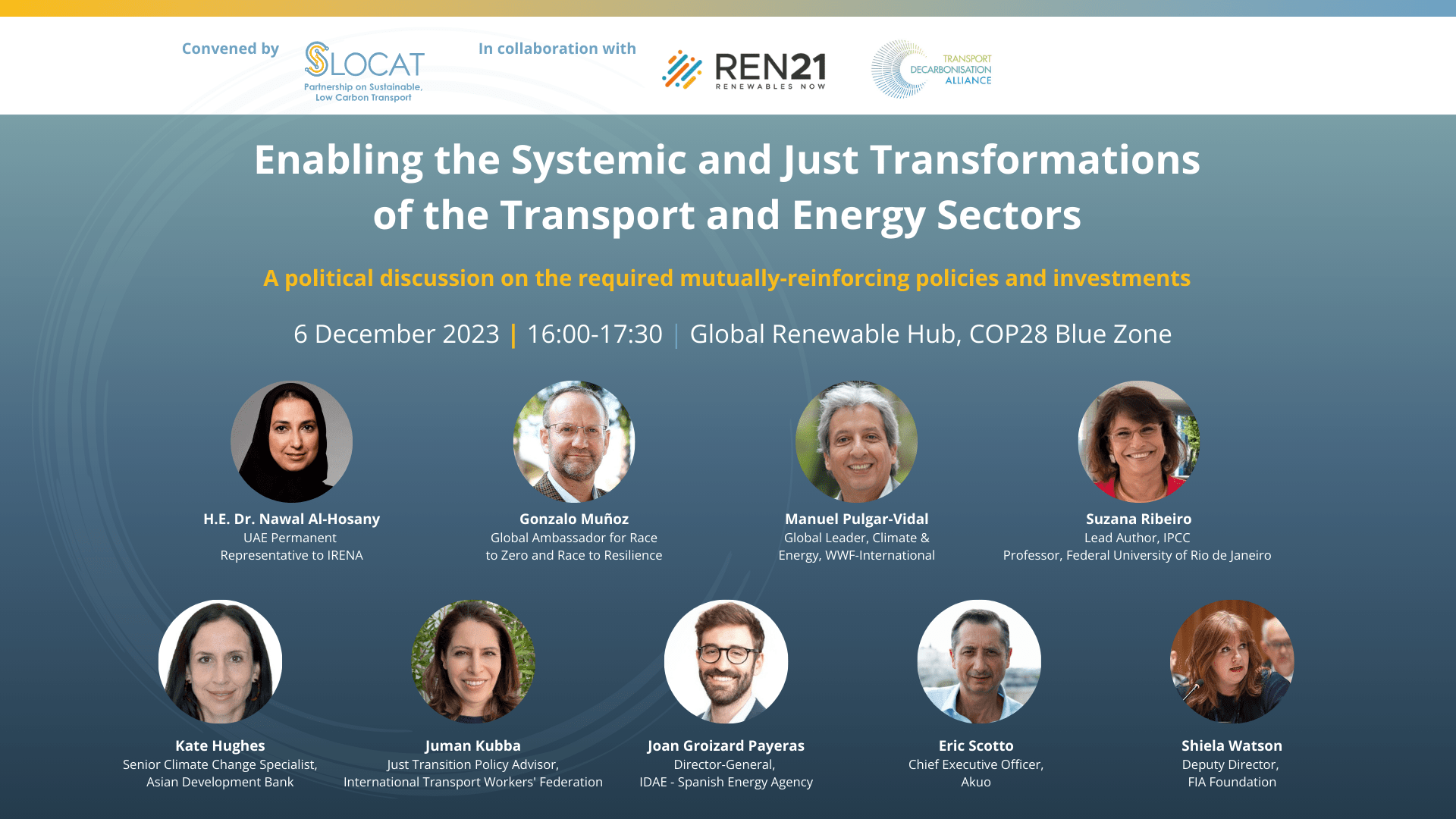
Enabling the systemic and just transformations
of the transport and energy sectors
A political discussion on the mutually-reinforcing
policies and investments required
6th December 2023 | 16:00- 17:30 | Global Renewables Hub, COP28 Blue Zone
In 2020, the movements of goods and people were responsible for 30% of the global total final energy consumption. Road and rail transport consumed 81% of transport-related energy.¹ Fossil fuels provided 95.9% of energy consumed in the transport sector, while renewables only 4.1% (REN21, 2023). Because of its dependence on fossil fuels and growth in transport demand, transport was responsible for 22% of global fossil CO2 emissions in 2019 (SLOCAT, 2023).² Most of the world’s population lacks access to affordable, safe, sustainable land transport and the demand for transporting people and goods is projected to increase substantially. This means that emissions, air pollution and energy demand from the land transport sector will also continue rising.
Both the transport and energy sectors must urgently decarbonise while guaranteeing equitable and affordable access to transport and energy services for all socio-economic groups, across high-, middle- and low- income countries (LMICs). Policies aimed at fostering the decarbonisation of transport will need to ensure an equitable and just transition towards more sustainable jobs. This transition, with potential job losses in fossil fuel-dependent regions, can result in a global net job gain, as shown by countries like China, Brazil, India, the USA and Europe (region), which are leading renewable energy jobs.³ Studies have also shown that employment benefits of sustainable transport investments exceed those of other sectors, especially in LMICs. Across 21 LMICs, investments in public transport and electric vehicles could create 50 million jobs by 2030.⁴
There are significant opportunities for mutually-reinforcing systemic transformations and just transitions of the energy and transport sectors when a shift to low energy intensity land transport modes is planned in tandem with a shift to energy efficient engines and low carbon energy. What are the trends? What is withholding action at scale? What policies and investments can enable the transformations at scale? Join us for a set of frank conversations among decision makers and stakeholders from the energy and transport sectors.
1 SLOCAT (2023), Transport, Climate and Sustainability Global Status Report – 3rd edition. www.tcc-gsr.com
2 REN21 (2023), Renewables 2023 Global Status Report. https://www.ren21.net/gsr-2023/
3 SLOCAT (2023), Transport, Climate and Sustainability Global Status Report – 3rd edition. www.tcc-gsr.com
4 Ibid.
Convened by In collaboration with