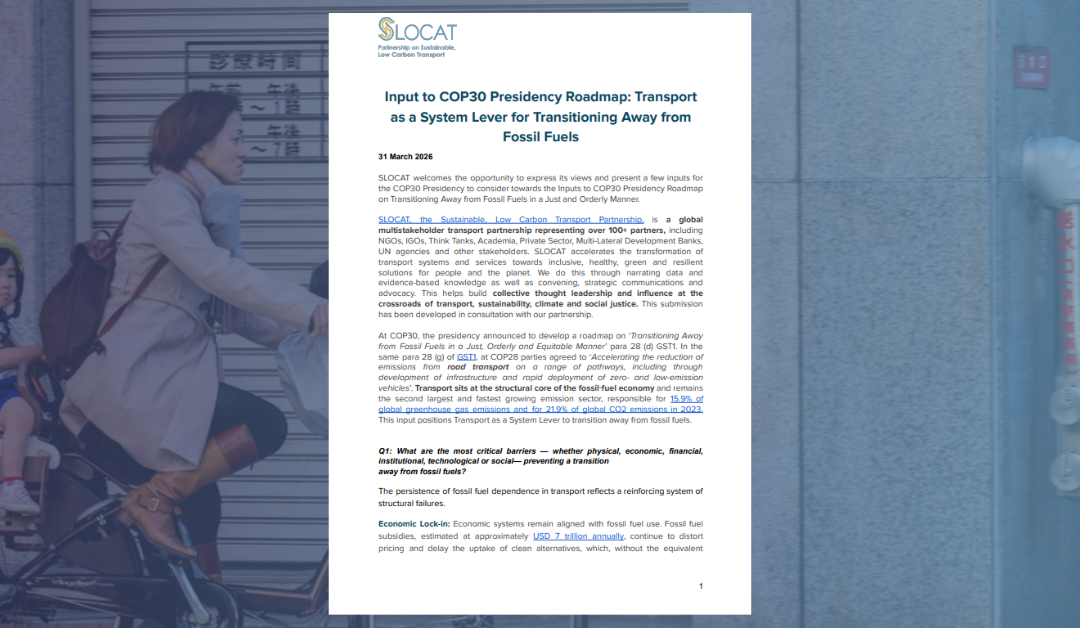
The Partnership for Sustainable, Low Carbon Transport (SLoCaT) has submitted its comments on the Programming Directions for GEF-6.to the Secretariat of Global Environment Facility (GEF) on September 9th, 2013. The comments were developed jointly by the Institute for Development and Transportation Policy and the Secretariat of SLoCaT; with contribution from the Asian Development Bank, Despacio, European Cyclists’ Federation, Sustainable Transport Africa and United Nations Environment Programme.
SLoCaT is pleased with the attention for transport in the GEF-6 draft strategy and wholeheartedly support GEF’s call that: “Sustainable transport urgently requires the timely development, demonstration, and financing of low-carbon systems and supportive policies, given the rapid increase of GHG emissions from the transport sources in developing countries”.However, notwithstanding the generally supportive tone of the programing document on sustainable transport, in the absence of transport sector-specific goals in GEF-6, SLoCaT is concerned that sustainable, low carbon transport, especially in urban areas, might face dilution of effort in the wake of other new broad objectives that are part of the strategy for the climate change mitigation (CCM) focal area. Sustainable transport should therefore be retained as an articulated objective with its own GEF-6 budgetary allocation. Special emphasis could be placed in GEF-6 on the role of transport within an integrated urban systems strategy, coupled with a sector specific funding allocation objective.
Based on current approvals it is likely that in GEF-5 (2010 – 2014), transport spending will go down. Of special concern is that only 30% of the total allocation for sustainable transport under the fifth cycle has been allocated. At the same time we find that countries and regional bodies are increasingly interested to make their transport sector more sustainable and low carbon – for multiple reasons. SLoCaT suggests a regular consultation mechanism between GEF and the SLoCaT partnership to determine the causes of the under utilization of GEF 5 sustainable transport financial allocations. Such a regular consultation mechanism can also be used to assist the GEF on outreach and effective implementation of sustainable transport under GEF 6.
For the full-text of the SLoCaT Partnership Comments, please see Supporting Sustainable Transport Action in GEF-6