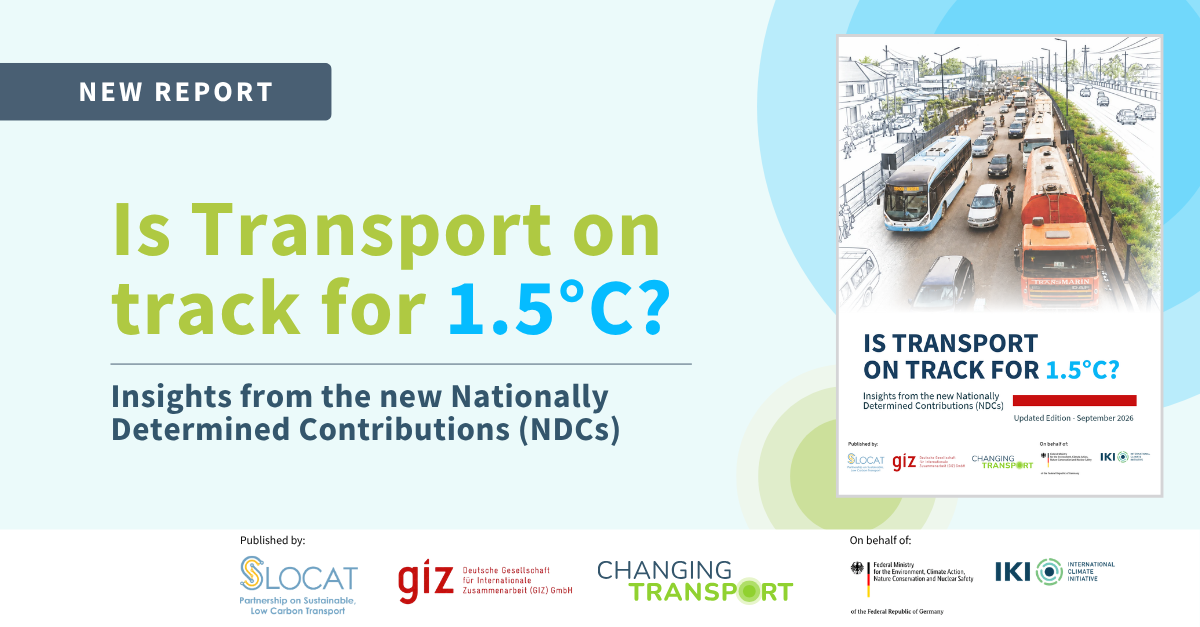
Insights from the new Nationally Determined Contributions (NDCs)
Updated Edition, September 2026 | Published by SLOCAT, GIZ and Changing Transport
Transport plays a central role in global efforts to limit warming to 1.5°C, yet it remains one of the most challenging sectors to decarbonise. Emissions from transport continue to grow, driven by rising demand, fossil fuel-dependent systems and slow structural change. The assessment of the third generation of Nationally Determined Contributions (NDCs) shows whether countries are responding to this challenge with sufficient ambition and depth.
This report finds that attention to transport in NDCs is increasing, but that current ambition remains misaligned with a 1.5°C pathway. The third-generation NDCs fall far short of this trajectory, with their aggregate economy-wide ambition instead pointing towards global warming of 2.3-2.5°C by the end of the century.
Key findings
Progress on transport ambition but not comprehensive enough. Transport-specific mitigation targets remain limited. Where targets are included, they are often slowing down emission growth, rather than aiming for absolute emissions reductions. The analysis of transport actions reveals a large bet on technology-led solutions, while policies aimed at reducing transport demand and shifting travel towards more efficient modes remain underrepresented and lack scale.
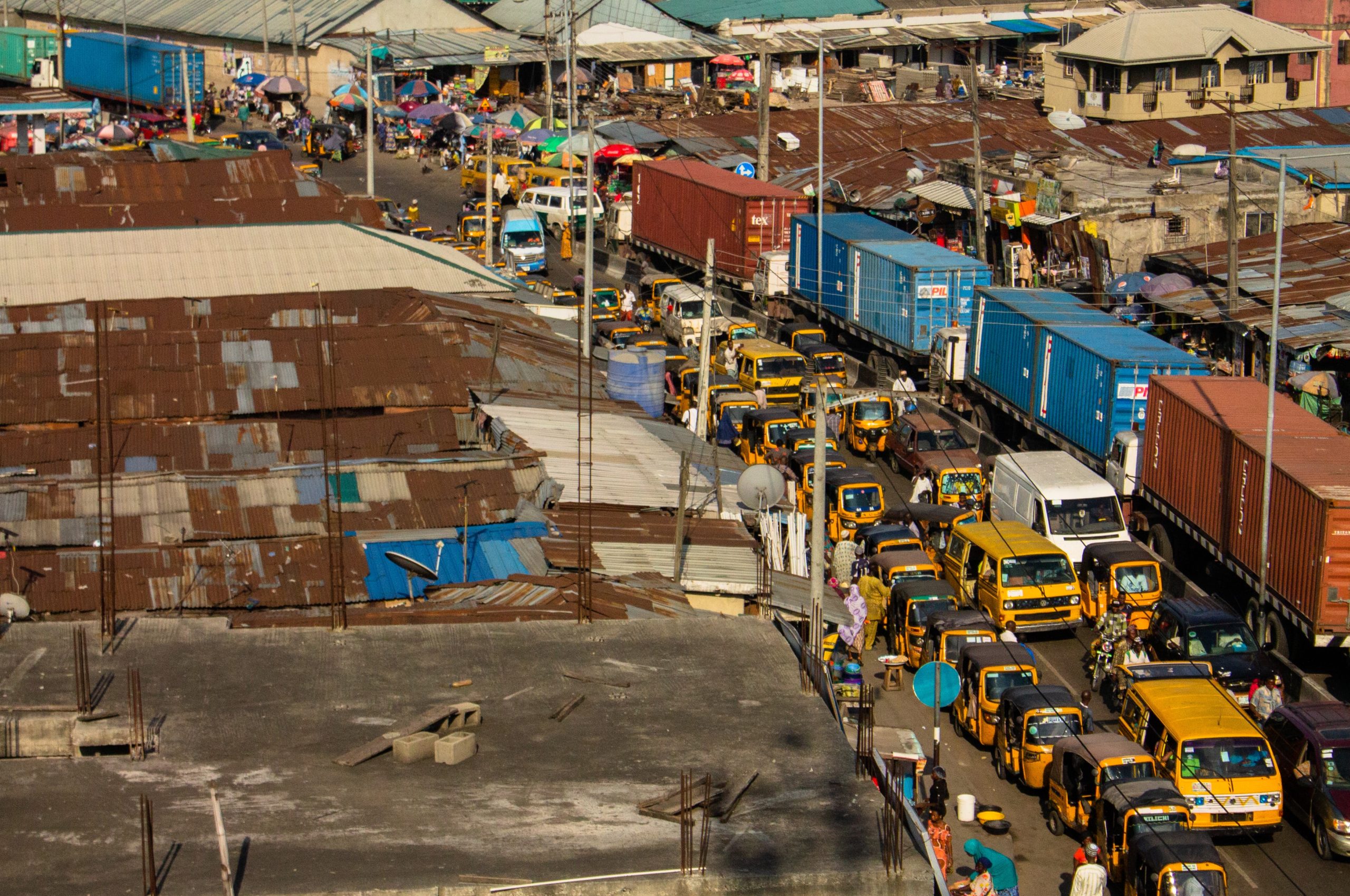
Blind spots continue in freight and other subsectors. Freight transport, informal transport, aviation and shipping are often overlooked. At the same time, future growth in transport emissions is expected to be concentrated in low- and middle-income countries, where capacity constraints and financing needs are most acute.
Transport needs to get ready for climate impacts. While references to transport adaptation have increased since second-generation NDCs, resilience remains a secondary priority in most NDCs. Adaptation measures in NDCs are descriptive and lack quantified targets and mode-tailored solutions.
Transport in NDCs at a glance
- 93% (119 NDCs) feature transport content, out of a total of 128 third-generation NDCs
- 20% (26 NDCs) feature a sector-wide GHG reduction target for transport; 7 more target a transport subsector
- 65% of all approaches towards implementing mitigation actions are represented by the “Improve” pillar (Avoid-Shift-Improve framework)
- 26% of actions (292) focus on electrification, dominating the total
- 15% (19 NDCs) feature a transport adaptation target
Moving forward, but not fast enough: a missed opportunity
Overall, third-generation NDCs signal progress in recognising the importance of transport for climate action but fall short of the ambition required for 1.5°C alignment. Closing this gap will require future NDCs to move beyond incremental improvements towards systemic transformation. Revisions to the stated ambitions are urgently needed to support achieving the goals of the Paris Agreement.
The report draws on the NDC Transport Tracker, developed jointly by GIZ, through the Mobilize Net-Zero project, and SLOCAT.