Nigeria has set out where it wants to go. The Climate Change Act, an updated NDC, the Energy Transition Plan and a target of net zero by 2060 describe a clear destination. Getting there is a different question, and much of the answer lies with the government, financiers and private sector working together. In transport, the private sector plays a critical role. They own large vehicle fleets, buy the fuel and make the daily operational decisions that determine how much fossil fuels are burned and how much contaminated air ends up in people’s lungs. Transport accounted for 18 per cent of Nigeria’s greenhouse gas emissions in 2024, and air pollution is linked to roughly 114,000 premature deaths in the country every year. Those numbers do not reduce unless transport businesses are equipped with enabling conditions to advance sustainable transport
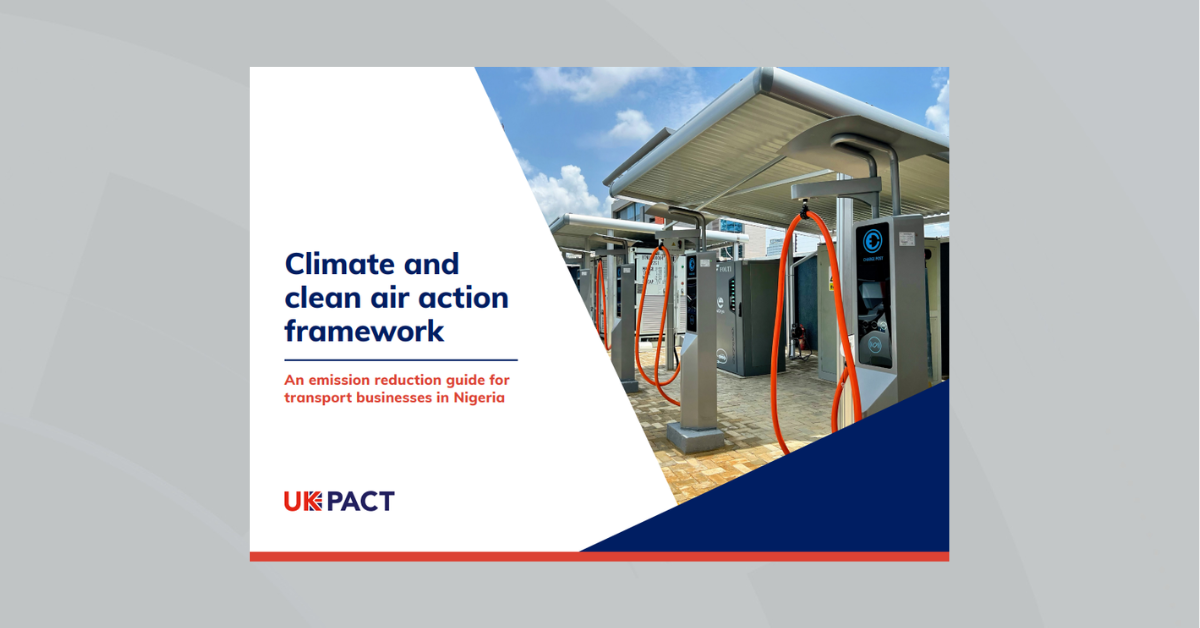
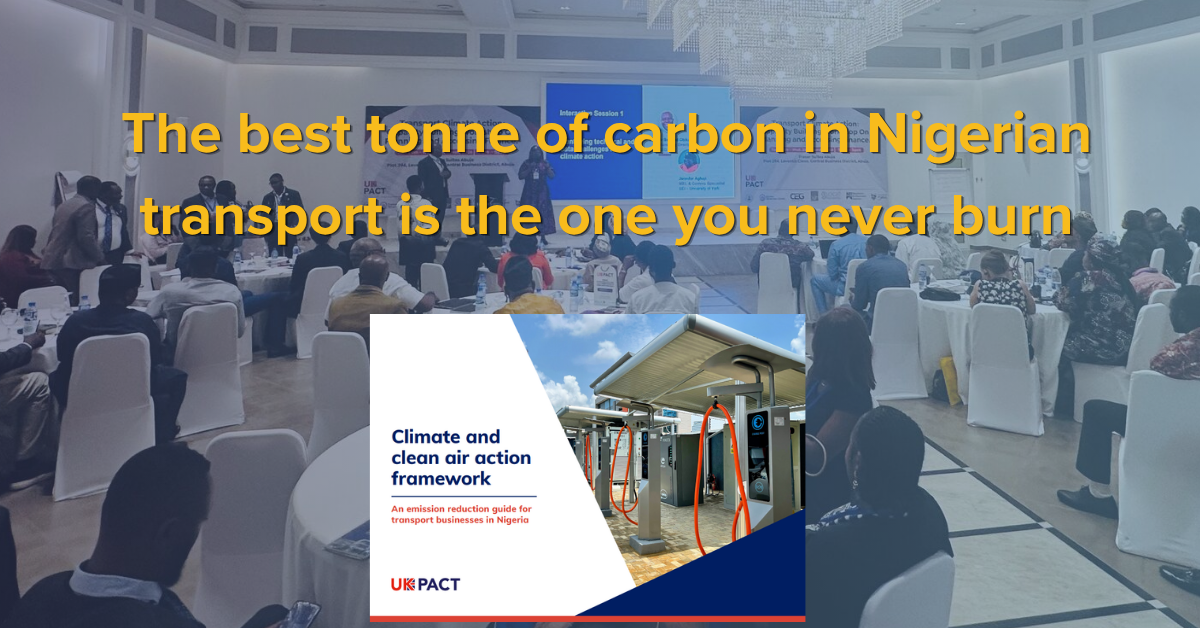
That is the gap the Climate and Clean Air Action Framework for Transport in Nigeria is built to close. This framework was developed by a consortium of the Stockholm Environment Institute and the University of York, Escher Silverman Global, CEG, AP3 and SLOCAT, with funding from UK PACT. SLOCAT co-developed the six-step approach at its core, and our colleague Genevivie Ankunda led the walk-through of its first steps at the launch webinar.
What makes the framework really worth reading is that it starts from a very basic assessment and completes with accessing climate finance and scaling up projects. But for most Nigerian transport operators the first and cheapest tonnes of carbon are not in a new vehicle at all. They are in the depot. Servicing vehicles properly, switching off idling engines, filling empty return trips and consolidating loads can cut fuel use by somewhere between 5 and 15 per cent, at low or no cost, starting immediately. The framework is anchored in this sequencing. It puts maintenance, anti-idling and tyre management in the “do first” column in terms of actions, and treats fleet renewal and electrification as the longer, more capital-intensive work that follows once the cheap wins are banked and the business case is clear.
This is Avoid, Shift and Improve applied to businesses: Avoid the unnecessary kilometre and the empty return leg. Shift freight to more efficient modes and better-loaded vehicles, and long-distance freight towards rail where it exists. Improve the vehicles, fuels and driving that remain. The same discipline that shapes a good national transport strategy also shapes a profitable, lower-emitting logistics company.
The framework also refuses to separate climate from clean air, and it is right to. The same idling engine that wastes diesel is the one filling a market street with smoke. One participant put it plainly: when a vehicle smokes too much, passengers who can walk away simply take another one, but a disabled passenger is often stuck. Cutting emissions and cutting the pollution people breathe are not two issues competing for attention. They are the same intervention, measured in an integrated manner.
None of this reaches scale without money, and this is where many good intentions stall. The framework treats climate finance as a skill to be built rather than a door to be knocked on. It walks a business from a mitigation measure to a bankable project and a short concept note that answers the questions a financier actually asks: what problem are you solving, what does it contribute to Nigeria’s targets, what is the measurable climate benefit, what will you actually do, and what support do you still need. For smaller operators, it points to aggregation, cooperatives, pooled procurement and shared infrastructure, as the route to a project large enough to fund.
Because SLOCAT and its partners kept asking who is in the room, the framework carries evidence from people usually left out of transport policy: women who organise local transport and supply chains, and entrepreneurs and passengers with disabilities who live with inaccessible, polluting services every day. A transition that ignores them is not a just one, and it will not be a durable one. Throughout the steps, the framework refers to the Nigerian context and uses Nigerian examples. Nevertheless, this framework is valuable for any transport business in emerging economies.
For SLOCAT, this is a concrete example of something we argue for globally: that sustainable transport belongs at the centre of climate and clean air action, and that the private sector is not a bystander to policy but the place where a large share of the emissions, and of the abatement, actually sits. The framework is free to use and built to be adapted.