Publication Date: December 2023
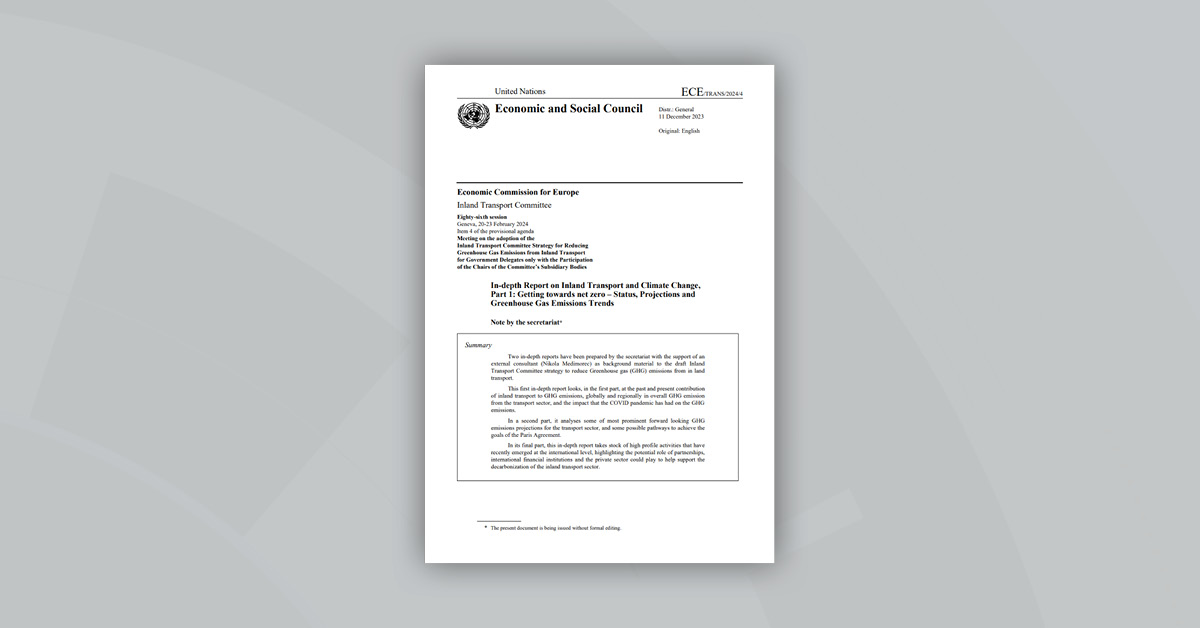
Developed under the United Nations Economic Commission for Europe (UNECE) Inland Transport Committee, this report supports the Committee’s strategy to reduce greenhouse gas (GHG) emissions from inland transport. It is part of a two-part background series prepared with the support of SLOCAT and an external consultant, intended to guide intergovernmental and sectoral action on aligning transport systems with the Paris Agreement goals.
This first report assesses inland transport’s historic and current contributions to climate change, models future emissions pathways, and evaluates how international commitments and financial mechanisms can accelerate decarbonisation. It brings together data, projections, and global policy trends to provide a science-based foundation for governments and stakeholders working on transport and climate policy.
Key messages:
- Inland transport is the largest contributor to global transport CO₂ emissions, responsible for 80% in 2021, with freight emissions growing rapidly and projected to exceed 60% of sector emissions by 2050.
- Without new policies, transport CO₂ emissions could rise by 16–50% by 2050, threatening climate targets and surpassing the sector’s fair share in a 1.5°C scenario.
- A just, regionally adapted transition using the Avoid–Shift–Improve (A–S–I) approach is critical, especially in low- and middle-income countries, to avoid carbon lock-in and secure climate-resilient mobility systems.
- Achieving net-zero transport by 2050 requires at least 59–90% emission reductions, major investments in electrification and infrastructure, and coordinated public–private action.
- There is a severe gap in climate finance for sustainable transport: less than 25% of needed investment is currently mobilised, with fossil fuel subsidies still rising.
The report uses a mix of historic emissions data (e.g. from EDGAR), scenario modelling (e.g. from IPCC, ITF, IEA), and policy analysis to map past trends, project future pathways, and identify key leverage points for emission reductions and investment shifts.