Climate ambition is pledged nationally. But transport gets decarbonised in places: in a Pacific port, on a freight corridor between two Asian cities, along a flood-prone road in West Africa. That is why SLOCAT is sharpening its regional focus. Impact does not come from a single scale. It comes from using all of them, and from meeting decision-makers where the work actually happens.
We have applied that regional lens now to our work on Nationally Determined Contributions. Together with GIZ, we maintain the NDC Transport Tracker, the joint database that records how countries treat transport in their climate plans. In 2015, SLOCAT was the first organisation to conduct a sectoral assessment of NDCs, looking at action by action and target by target. Over the years, SLOCAT’s assessments of transport in NDCs helped to raise ambition and action on sustainable mobility in the climate change process. That analytical layer is what turns a list of submissions into insights that a negotiator or planner can use. Decision-makers take inspiration from neighboring countries in their region, thus regional insights accelerate ambition. We have now taken that data and built it into the next generation of online dashboards, revolutionising SLOCAT’s knowledge work: interactive, comparable across regions, and designed to be used, analysed, and accelerate implementation rather than just downloaded.
As of 26 May 2026, 118 third-generation NDCs have been submitted, covering 85% of all potential submissions. Of those, 88% include actions to cut transport emissions, and 64% include actions on transport adaptation and resilience. Those headline numbers matter, but the regional picture is where the dashboard earns its place. Each region carries a distinct signature, and seeing them side by side tells you more than any global average.
This regional NDC dashboard has been released in time for the 64th sessions of the UNFCCC Subsidiary Bodies (SB 64), which are taking place in Bonn (Germany) from 8-18 June 2026 as well as ahead of Conference of Parties COP31 to be held in Türkiye, Istanbul. It is accompanying SLOCAT’s Transport and Climate Change Briefing Note for negotiators and stakeholders advancing discussions on transport across different work programmes.
Africa: the lowest emissions, the strongest ambition
Africa contributes the least to global transport emissions and yet stands out as the region with the strongest future ambition. Eleven of its NDCs carry a quantified target to reduce transport greenhouse gas emissions, which is 31% of all such targets worldwide. Ten carry targets to make transport more resilient to climate change, which is 56% of every transport adaptation target on the planet. No other region comes close to resilience. That reflects acute climate vulnerability translated into commitment, with infrastructure resilience dominating the adaptation actions, whereas electrification and public transport are leading the mitigation. For decision-makers across the continent, the dashboard shows where their country sits relative to neighbours who have already put figures and ambition on the table.
Asia: the most action, with rail at the centre
Asia records the largest number of transport mitigation actions of any region, 303 across 32 NDCs, just over a quarter of the global total. Several Asian NDCs build their mitigation around rail: electrifying networks, and shifting road freight onto rail and inland waterways. Seven NDCs carry quantified transport mitigation targets, second only to Africa. The scale of activity here is a regional asset, and the dashboard makes it legible for the planners and ministries who need to benchmark their own ambition against the busiest transport-NDC region in the world.
Europe: near-universal coverage, stronger on Avoid
Nearly every European country has submitted a third-generation NDC, whether through the European Union’s collective submission or individually. The EU aims to halve emissions from new cars and vans by 2030 against 2021 levels, reaching 100% by 2035. What sets the region apart is its Avoid profile: Europe has the highest share of demand-reducing actions of any region, driven by Sustainable Urban Mobility Plans in the Republic of Moldova and commitments to cut car journeys in favour of active travel in the United Kingdom. Europe shows that mature frameworks can push ambition upstream, towards avoiding motorised demand rather than only cleaning it up.
Latin America and the Caribbean: planning and modal shift at scale
The region shows the strongest combined share of Avoid and Shift actions in transport, the result of a deliberate focus on transport planning and public transport development. Its Shift share sits at 34.5% against a global average of 27%, and it leads every region on transport system improvements, anchored in comprehensive planning and freight efficiency. This is what a modal-shift agenda looks like when it is written into national climate plans, and the dashboard lets ministries across the region see how their own commitments compare against that pattern.
North America: mode shift and electrification, no quantified targets
North America is represented by Canada and the United States, both of which have submitted NDCs. Their plans concentrate on mode shift and electrification, supported by economic instruments and public transport improvements. The region is notable for the absence of quantified transport mitigation or adaptation targets, a gap the dashboard makes visible at a glance and which regional stakeholders can read as an open question rather than a closed file.
Oceania: connectivity, written in aviation and shipping
Oceania’s profile is shaped by island geography and maritime dependence. The region records the highest share of aviation and maritime actions anywhere, reflecting how central shipping and air links are to Pacific Island states. Seven Pacific NDCs carry quantified transport greenhouse gas mitigation targets, several reaching towards decarbonised domestic shipping by mid-century. For a region where transport connectivity is essential, the dashboard surfaces ambitions that a global view would otherwise flatten.
Built to be used, and to keep growing
This regional dashboard is not a standalone artefact. It feeds into the Transport Data Commons Showroom and into the ‘Data in Action’ section of the NDC Transport Tracker, placing SLOCAT’s analysis where practitioners already look for transport data. It will be updated as new NDCs are submitted, growing towards a one-stop hub for transport in national climate commitments.
More than a product, it is a demonstration. It shows what SLOCAT’s regional knowledge can do when it is built for the people making decisions within a region, and how that knowledge can reach more stakeholders and shape more conversations than a single global headline ever could. The plans are national. The work is regional. The dashboard is where the two meet.
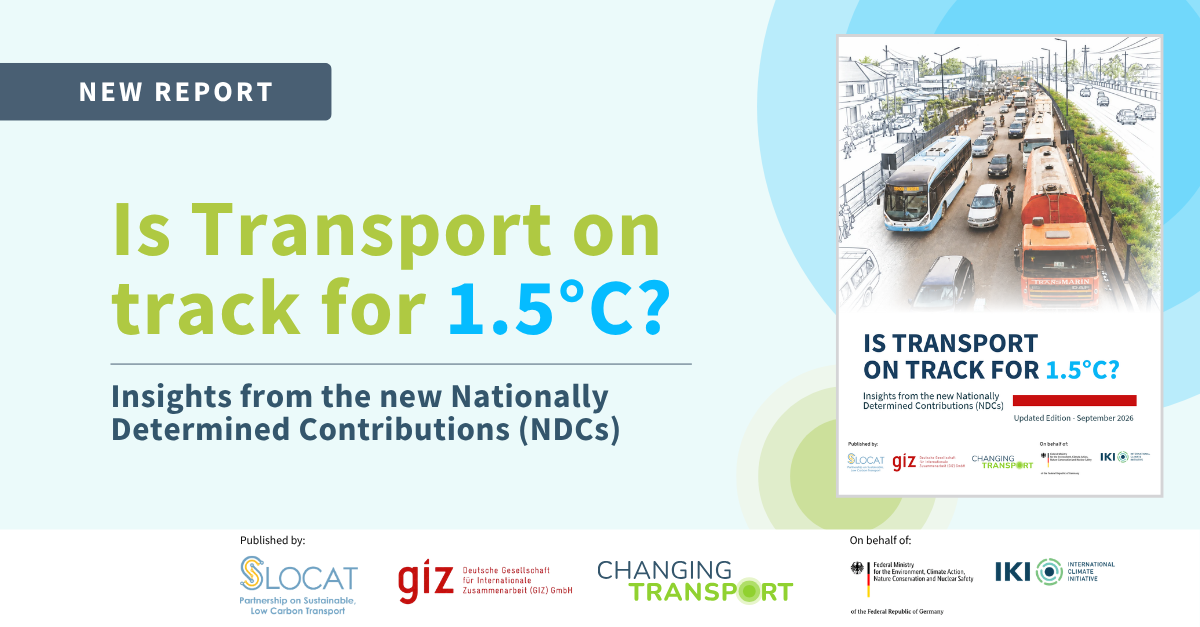
Based on the NDC Transport Tracker, a joint database by GIZ and SLOCAT. For a full and detailed assessment, see our report Is transport on track for 1.5°C? Insights from the new NDCs. Data as of 26 May 2026.