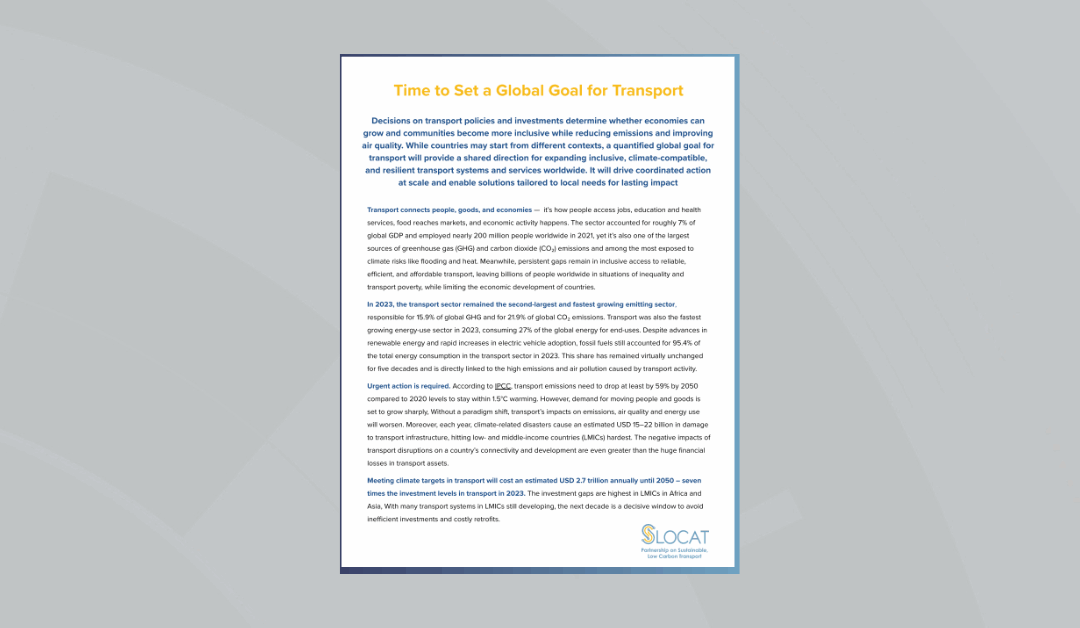
According to IPCC transport emissions need to drop at least by 59% by 2050 compared to 2020 levels to stay within 1.5°C warming. Transport is the lifeline of our societies and economies connecting people and the economies, yet the sector is a leading contributor to emissions. In 2023, it remained the second largest and fastest growing emitting sector – responsible for 15.9% of global greenhouse gas emissions and 21.9% of global CO₂ emissions – and consumed 27% of global energy for end-uses, with fossil fuels accounting for 95.4% of energy used in transport. Moreover, the transport sector is among the most exposed to climate risk. Climate-related disasters cost USD 15 – 22 billion in damage to transport infrastructure every year, hitting low- and middle-income countries (LMICs) hardest. Meanwhile, billions of people still lack access to safe and reliable transport, limiting social inclusion and economic development. The urgency to act has never been greater.
Produced by SLOCAT, these Takeaways for Decision Makers distil key findings from the SLOCAT Transport, Climate and Sustainability Global Status Report – 4th edition (GSR4) provide actionable insights at the crossroads of transport, climate, sustainability and social justice – supporting decision makers in accelerating a just transition towards sustainable, low-carbon transport systems.
The report highlights both progress and persistent challenges. Over the past two years, some progress has been achieved towards sustainable transport across all modes and levels of governance, providing a foundation to build upon. However, the overall trajectory of transport transformations remains off track for achieving a truly sustainable future.
The report reflects momentum in global frameworks, including the UN Decade of Sustainable Transport (2026-2035) and the first Global Stocktake of the Paris Agreement, which called for reducing road transport emissions and transitioning away from fossil fuels. The International Maritime Organization’s 2023 GHG Strategy set targets to cut international shipping emissions 20-30% by 2030 and 70-80 % by 2040, while the International Civil Aviation Organization adopted a Long-Term Aspirational Goal to achieve net-zero carbon emissions from international aviation by 2050.
National and subnational governments are acting too – strengthening urban-rural connectivity, tightening vehicle emission standards and maritime emissions, investing in rail, road transport electrification and sustainable aviation fuels, and advancing cleaner urban mobility through expanded emission zones, congestion pricing, transit-oriented development, and parking reforms.