
From Insight to Impact, Together
Mobilising Towards a Global Goal for Transport
Decisions on transport policies and investments determine whether economies can grow, communities become more inclusive, and emissions and air pollution are reduced.
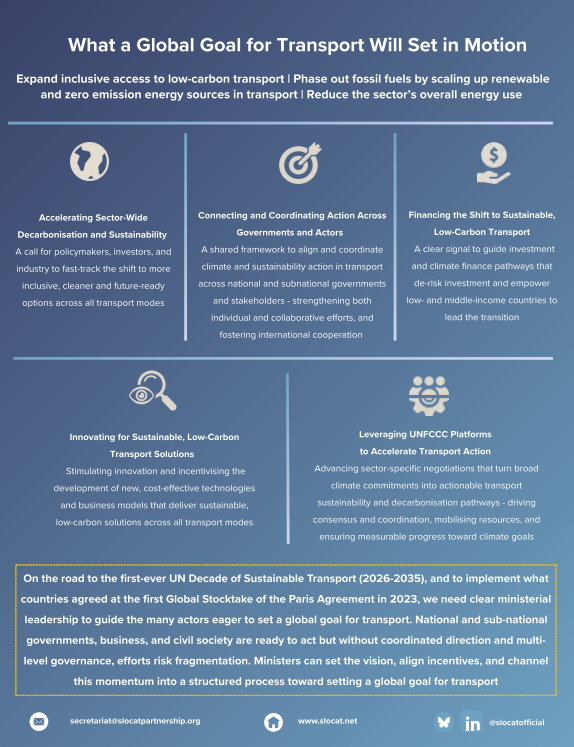
While countries start from different contexts and capacities, a quantified Global Goal for Transport will provide a shared direction to expand inclusive, climate-compatible, and resilient transport systems and services worldwide. Such a global goal will drive coordinated action at scale, while enabling solutions tailored to local needs for lasting impact.
Last year, SLOCAT engaged in targeted advocacy in the lead-up to the United Nations Climate Change Conference COP30, widely dubbed as “the COP of COPs”. Our efforts aimed to elevate transport within climate and sustainability agendas and commitments, building momentum and support for the adoption of a Global Goal for Transport. Through these strategic interventions, SLOCAT continues to mobilise actors, policies, and investments – guiding the sector towards a shared vision for a sustainable future.
Transport connects people, goods, and economies – it’s how people access jobs, education and health services; how food reaches markets, and how economies thrive. The sector produces 7% of global GDP and employs nearly 200 million people, yet it remains one of the largest sources of emissions and among the most vulnerable to climate risks like flooding and heat. Meanwhile, billions of people still lack access to safe, reliable, and affordable transport, limiting social inclusion and economic opportunity.
In 2023, transport remained the second largest and fastest-growing emitting sector, responsible for 15.9% of global greenhouse gas emissions and 21.9% of CO₂ emissions. It was also the fastest growing energy-use sector, consuming 27% of global end-use energy, with 95.4% still from fossil fuels – a dependency virtually unchanged for 50 years, responsible for transport’s high emissions and air pollution.
The urgency to act has never been greater. The IPCC warns transport emissions must drop by at least 59% by 2050 to stay within 1.5°C of warming. Yet, demand for moving people and goods continues to soar. Without a paradigm shift, transport’s impacts on emissions, air quality and energy use will worsen. Each year, climate-related disasters already cause USD 15–22 billion in damage to transport infrastructure, hitting low- and middle-income countries (LMICs) hardest. Under current policies, the sector could face 97.8% transport infrastructure loss by 2050 – the most severe impact of any sector. Beyond the financial toll, disrupted transport connectivity undermines economic development and social stability.
Meeting climate targets in transport will require USD 2.7 trillion annually until 2050 – nearly seventimes 2023 investment levels – with the largest gaps in Africa and Asia. With transport systems still developing in LMICs, the next decade is a decisive window to avoid inefficient investments and costly carbon lock-in.
Despite economic and political headwinds, this is also a moment of extraordinary opportunity. The choices made now on transport policy and investment will determine whether economies can grow and communities become more inclusive while reducing emissions and improving air quality. Aligning transport transformations with social inclusion, decarbonisation, energy transition and resilience will unlock innovation, investment, and shared prosperity worldwide.