Freight transport and logistics sits at the heart of the global economy, moving the goods that sustain livelihoods, supply chains, and development. It also sits at the heart of the climate challenge. Without decisive action, freight greenhouse gas emissions could increase by nearly 30% between 2019 and 2050. With the UN Decade of Sustainable Transport (2026–2035) now underway, the window for transformative action on freight transport and logistics is open, and the need for clear guidance has never been greater.
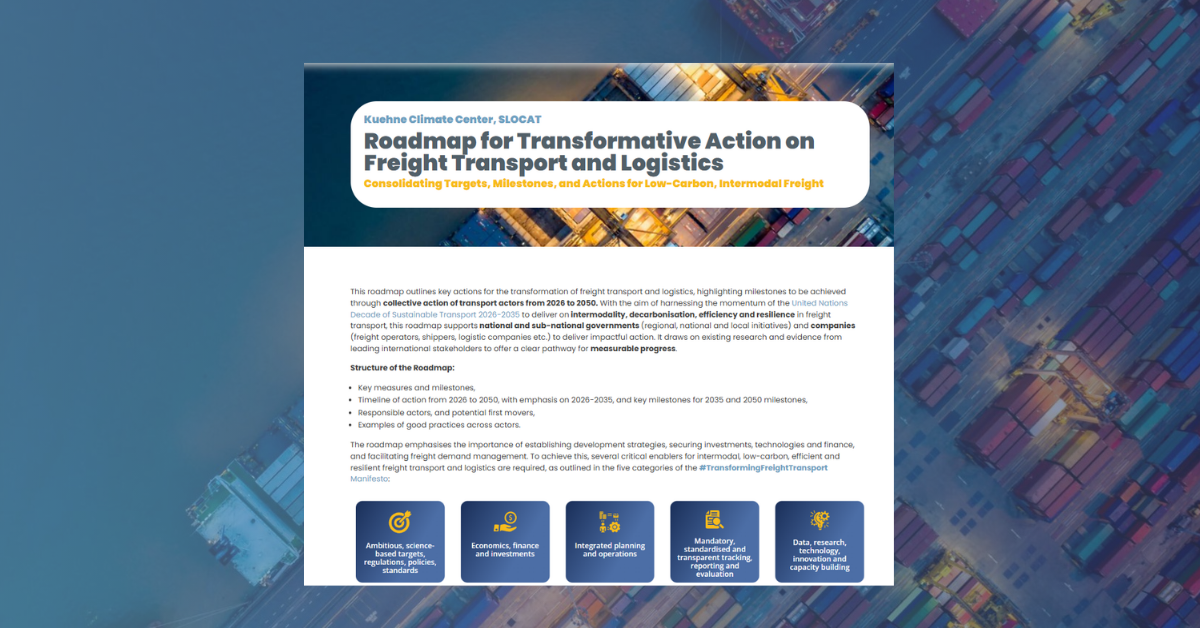
SLOCAT and the Kuehne Climate Center are pleased to share the Roadmap for Transformative Action on Freight Transport and Logistics, an interactive publication consolidating targets, milestones, and actions for low-carbon, intermodal freight from 2026 to 2050.
From Vision to Action
The roadmap builds on the Manifesto for intermodal, low-carbon, efficient and resilient freight transport and logistics, launched in 2024 at the first UN Global Supply Chain Forum and now backed by more than 45 signatories. It also draws on the Compendium of Policies and Investments, co-initiated by SLOCAT and the Kuehne Climate Center, which identifies best-value policies and investment approaches for near-term results and long-term transformation.
Together, these resources translate a shared vision into a pragmatic, evidence-based pathway, one that governments, companies, freight operators, and logistics providers can use to advance their own ambition.
A Timeline for Transformation
The roadmap is structured around a clear timeline, with priority focus on the 2026–2035 period, and milestone checkpoints through to 2050. The roadmap consolidates targets, milestones, and actions for low-carbon, intermodal freight.
Some of the headline milestones include:
- By 2026, only electrified railways should be constructed or only electric locomotives should be introduced.
- By 2027, every freight transport mode should be covered by a carbon pricing mechanism, providing financial incentives aligned with decarbonisation.
- By 2030, low-carbon freight targets should be achieved across modes, including 37% of heavy-duty trucks electrified, 65% electricity share in rail energy, and a 14% reduction in heavy truck emissions from 2020 levels.
- By 2035, only electric vans should be sold globally, every city should have zero-emission zones and sustainable urban logistics plans in place, and 65% of new truck sales should be electric.
- By 2040, only electric trucks should be sold, with advanced economies and China expected to end fossil-fuel truck sales by that date.
- By 2050, full decarbonisation of freight transport should be achieved, with 45–50% of goods shifted from road to rail and inland waterways.
Why This Matters Now
The science is unambiguous. The Paris-aligned high-ambition scenario from the International Transport Forum requires global freight emissions to peak at 3.9 gigatonnes of CO₂ equivalent in 2026, this year, before declining by 75% by 2050. Under current climate ambitions, the carbon budget consistent with limiting warming to 1.5°C would be exhausted by 2032. Any further delay in implementation makes that target significantly harder to reach.
The roadmap is explicit that early action is not optional. Establishing freight decarbonisation strategies, setting greenhouse gas reduction targets, investing in intermodal terminals and ports, mobilising finance for low-carbon maritime transport, scaling zero-emission road freight technologies, these are not distant aspirations. They are actions that should begin now, in 2026, in parallel with the momentum of the UN Decade.
A Resource for Every Actor
One of the roadmap’s strengths is its attention to responsibility and pointers to good practices. For each action and milestone, it identifies first movers, often national and subnational governments in upper-middle and high-income countries, or forward-looking companies, followed by a broader set of actors expected to follow. Examples of good practice from across the world illustrate what is already possible: Denmark’s CO₂-differentiated kilometre-based road toll for trucks, India’s target to raise rail freight share from 27% to 45% by 2031, France’s rail freight share goals, Panama Canal’s low-carbon vessel incentives, and the EU’s Alternative Fuel Infrastructure Regulation, among many others.
The roadmap is non-prescriptive: it acknowledges that actual implementation will vary depending on national context, institutional capacity, and market maturity. It is designed as a high-level guidance document, a reference point for designing approaches, assessing progress, and signalling the scale of transformation required.
According to Mark Major, Senior Director Strategy, Kuehne Climate Center: “Transforming logistics to be more sustainable will reduce costs and increase the benefits of trade – the roadmap sets out clearly how that can be done in proven pragmatic steps”.
Explore the Interactive Roadmap
The roadmap is available as a fully interactive online resource, allowing users to click through the timeline, explore actions and milestones, and access supporting references and examples.
Feedback on the roadmap is welcome at secretariat@slocatpartnership.org.
The Roadmap for Transformative Action on Freight Transport and Logistics was developed by SLOCAT and the Kuehne Climate Center. The Manifesto for intermodal, low-carbon, efficient and resilient freight transport and logistics was launched in collaboration with ALICE, CONCITO, IDDRI, International Transport Workers’ Federation, Smart Freight Centre, International Union of Railways (UIC), and World Resources Institute (WRI).