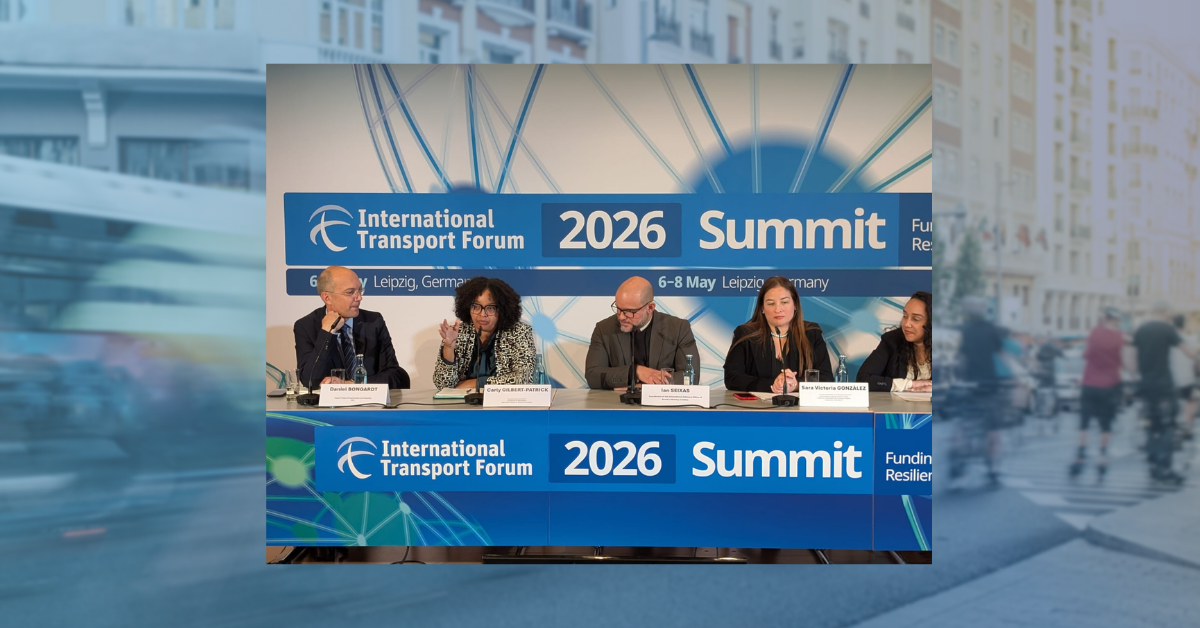
The 2026 ITF Summit in Leipzig brought together transport ministers, multilateral institutions, financiers, operators, and civil society around the theme of resilience. For SLOCAT, it was a moment to push a single message into the heart of the global transport conversation: the sector needs a North Star, and that North Star is a Quantified Global Goal for Transport.
Why a Global Goal, and why now
Decisions on transport policies and investments determine whether economies can grow and communities become more inclusive while reducing emissions and improving air quality. Countries start from very different contexts, but a quantified global goal for transport would provide a shared direction: expanding inclusive access to low-carbon transport, phasing out fossil fuels by scaling up renewable and zero-emission energy sources, and reducing the sector’s overall energy use. It would drive coordinated action at scale while leaving room for solutions tailored to local realities.
That is the framing SLOCAT brought to Leipzig, and the framing that ran through every room our team stepped into.
One voice in the rooms that mattered
SLOCAT Secretary General Carly Gilbert-Patrick carried the Global Goal message into some of the Summit’s most consequential sessions.
At the Ministers’ Round Table on vision-led planning, she made the case that demand is not a “given” and need bold action to decrease it. Forecast-led plans lock in self-fulfilling car dependence, while vision-led planning can intentionally deliver Avoid, Shift and Improve outcomes. A Quantified Global Goal for Transport, she argued, would give vision-led planning an international North Star and a common language so that countries can set comparable targets on access, safety, energy demand and emissions, and track delivery to 2035. The Ministerial Declaration at COP30, initiated by Chile, now chaired by the Dominican Republic where 11 countries pledged to reduce transport energy demand by 25% by 2035 with one-third of that energy coming from renewable sources and sustainable biofuels, was held up as proof that a coalition of the willing can move first.
At the Infrastructure Investment for the SDGs session, alongside the Netherlands, the Asian Development Bank, Colombia and the Kuehne Foundation, SLOCAT called on the transport community to stop leaving 40 to 60% of potential emission cuts on the table while the sector remains locked into fossil fuel dependence. Many global and regional frameworks already exist, from the UN Decade of Sustainable Transport to the Chile Declaration. The call to action is to adopt and accelerate their implementation with a unified voice.
At the UN DESA-led dialogue on monitoring progress under the UN Decade of Sustainable Transport, the conversation centred on connecting existing frameworks rather than creating new ones, and on focusing the Decade on areas where it can add real value. Member states pointed to the need for a unifying space, key indicators, and a way to bring more countries into existing commitments such as the Chile Declaration. Ethiopia, ahead of its COP32 presidency, voiced support for a global goal for transport.
From Declaration to Action
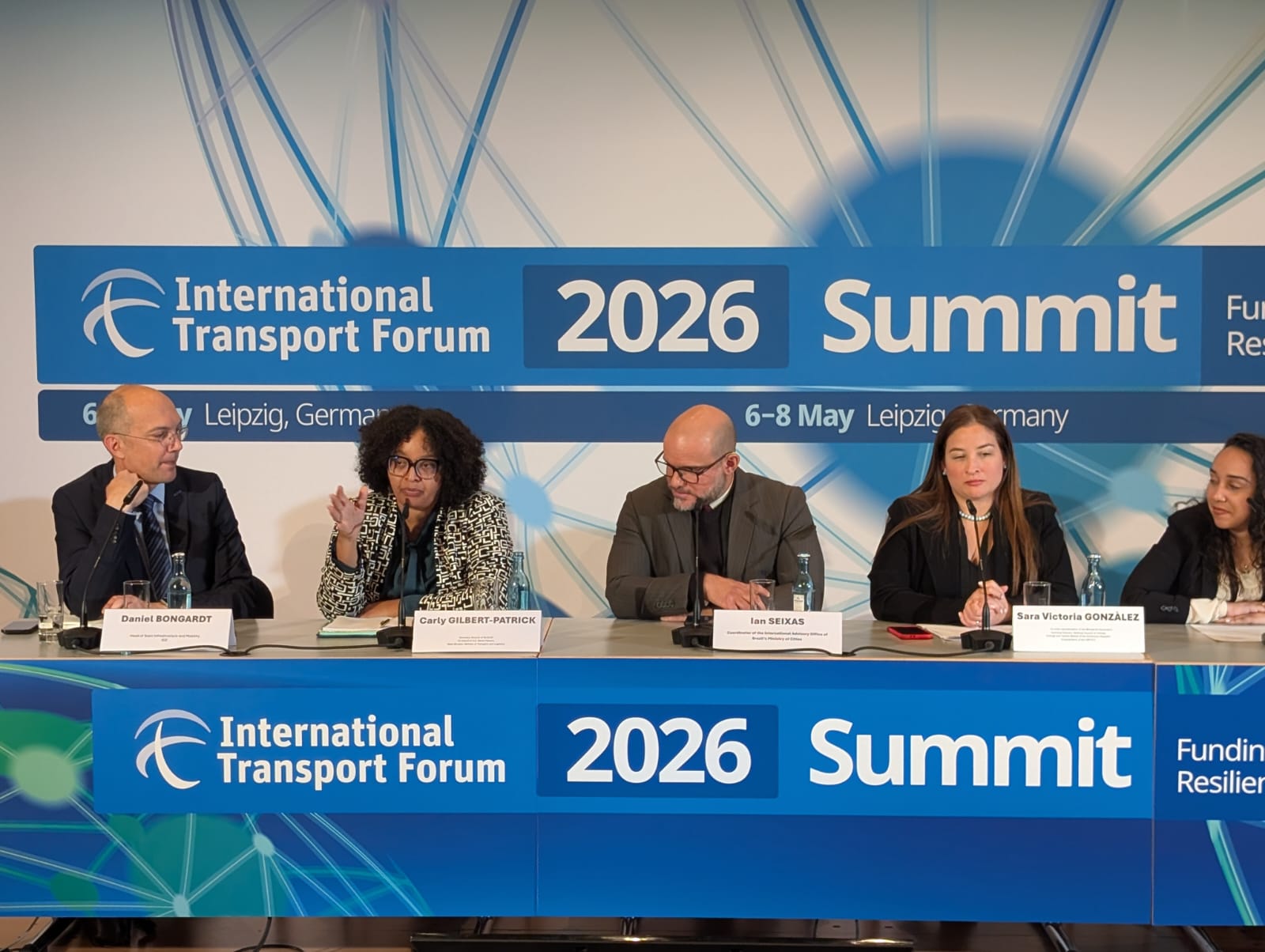
The press conference From Declaration to Action: Putting Transport at the Heart of Climate Policy was a turning point where our Secretary General, Carly Gilbert-Patrick represented our Partnership and brought a very important voice. The Dominican Republic announced it would co-chair the COP30 Chile Declaration, framing it not as a national statement but as an international call to act on transport. Colombia spoke of a politics of life, and the practical work of putting it into mobility systems. Ethiopia, not present in the room, but in the discussion through a written statement, continue drawing on its ban on internal combustion engine vehicle imports and its incoming COP32 presidency, presented fossil fuel phase-out as a practical, people-centred path built on avoiding trips, shifting to public and active transport, and moving to renewable energy.
SLOCAT spoke in support, positioning the Declaration as a clear head start toward the Quantified Global Goal for Transport that the sector now needs.
Avoid and Shift back on the table
In a freight-focused exchange alongside KCC, UIC, the Climate Champion Team and UN DESA, SLOCAT’s Campaigner and Communication Specialist, Jules Vincent, brought hard data into a discussion too often skewed toward technology fixes. Today, 95.4% of transport energy still comes from fossil fuels, and freight is a major part of that picture. Yet the global response remains overwhelmingly focused on Improve strategies. Avoid and Shift, where 40 to 60% of potential emissions cuts sit, are still treated as secondary. That gap is now firmly back on the agenda.
The road from Leipzig
Leipzig confirmed what we already suspected. The frameworks exist. The coalitions are forming. The data is clear. What is still missing is alignment, a unified voice, and a shared destination. Starting in 2026, the UN Decade of Sustainable Transport will be a critical platform to foster inclusive, coordinated and transformative progress, and a Quantified Global Goal for Transport will give it the direction it needs.
SLOCAT will keep working with its partners to build that voice, all the way to SB64 in Bonn, HLPF 2026 in New-York, COP31, and beyond.