A new global declaration on transport data, signed by 42 organisations across five continents, sets out what it will take to make the UN Decade of Sustainable Transport a decade of evidence rather than estimation. Here is why it matters, and how to add your name.
The world is waiting for greater leadership, political will, investment, and enabling frameworks to accelerate transport transformations worldwide. The first-ever UN Decade of Sustainable Transport, running from 2026 to 2035, is the platform meant to channel that ambition. It carries a clear mandate: systematically monitor and track progress across six focus areas, from climate to access to road safety. The mandate is right, the infrastructure to deliver it is not yet in place.
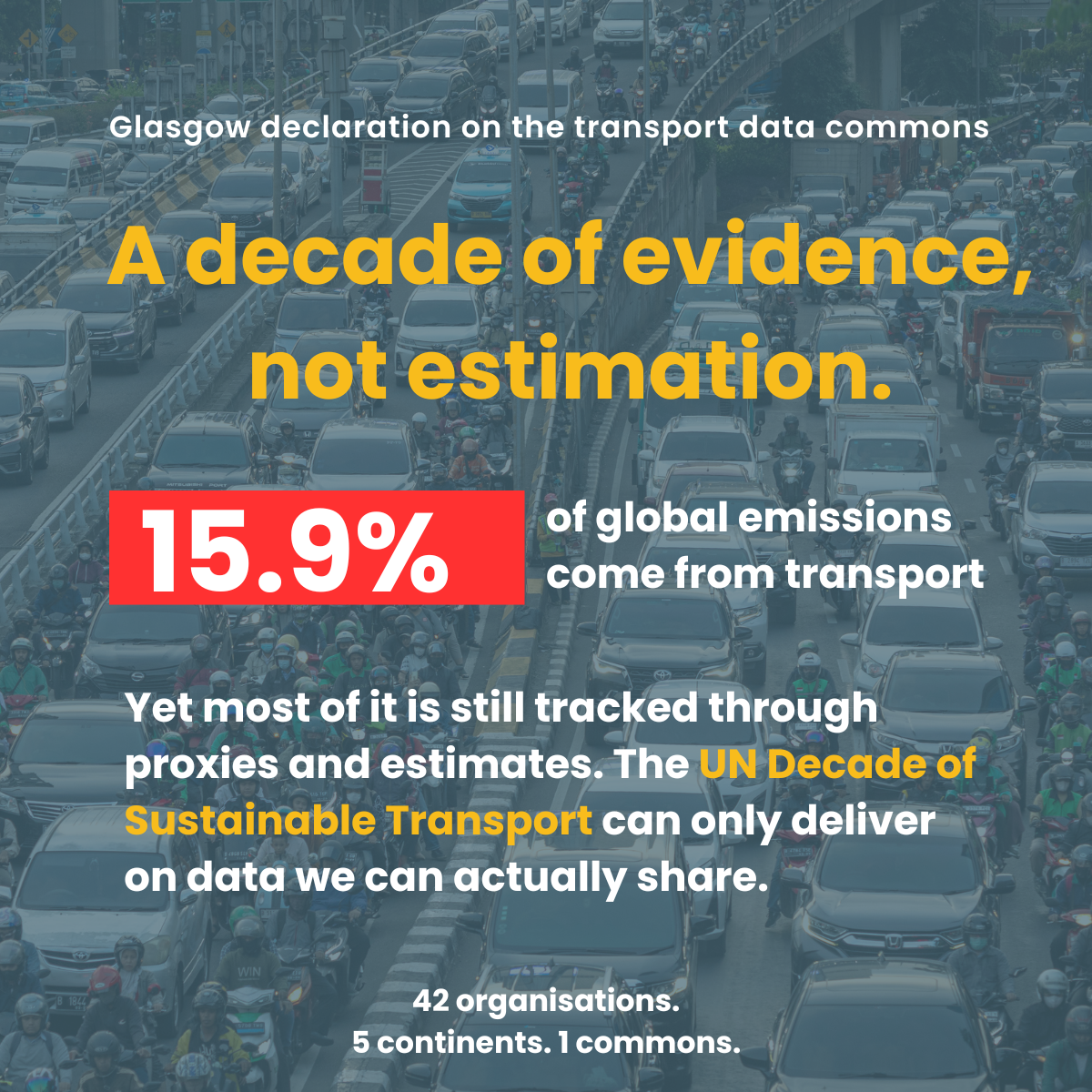
Anyone who has tried to build a credible global picture of transport knows the shape of the problem. Datasets are scattered across ministries, banks, consultancies and research institutes. Definitions diverge. Methodologies are inconsistent. Some figures are paywalled, others are buried in PDFs, and many of the most important ones, particularly in low- and middle-income countries, simply do not exist. The result is a sector responsible for 15.9% of global greenhouse gas emissions, still 95.4% dependent on fossil fuels, and yet routinely tracked through proxies, assumptions and best guesses. Data and transparency deficits run through every part of the system, from emissions to finance flows to the progress of fossil fuel phase-out.
Without better data, the Decade risks becoming a ten-year exercise in narrating progress rather than measuring it.
SLOCAT joined the declaration, on this occasion Carly Gilbert-Patrick, Secretary General, said: “We have the solutions and tools at our fingertips. What we still lack is the shared evidence base to direct them at the scale and speed the Decade demands. The Glasgow Declaration treats transport data as the global public good it has always needed to be, and gives the UN Decade of Sustainable Transport the foundation it needs to deliver.”
A commons for a global public good
The Glasgow Declaration on the Transport Data Commons, launched on 24 February 2026 at the Transport Data Commons (TDC) Global Launch workshop hosted by the University of Strathclyde, is a direct response to that risk. Co-developed by 60 international delegates representing 42 organisations across five continents, including SLOCAT, the Declaration sets out 15 calls to action across data sharing, capacity building and sustainable financing. It was presented to the wider transport community at the Transforming Transportation conference in Washington, D.C., on 9 March 2026, and the declaration remains open to all who want to join, individuals, organisations or academics.
The TDC was conceived in 2022 at a side event of the International Transport Forum in Leipzig, hosted by GIZ. The premise was simple, and overdue: transport data should be treated as a public good. Findable, accessible, interoperable and reusable. Governed openly. Built collectively rather than locked inside any single institution. Since the onset, SLOCAT has been providing strategic advice and contributions to data work. Four years on, the TDC has launched an open data portal, developed open source tools, run major data collection exercises with national governments and local researchers in Ghana, Kenya, Malawi and Zambia, and built formal collaboration with more than 30 international partners. Its work has been included as a Voluntary Commitment towards the UN Decade.
Why this matters for the Decade
Decisions on transport policies and investments determine whether economies can grow and communities become more inclusive while reducing emissions and improving air quality. Without a shared evidence base, those decisions are made in the dark, and the gaps fall hardest where transport development is most urgently needed.
The Declaration’s calls are concrete. It asks governments to publish transport data in machine-readable formats and to nominate national TDC focal points. It asks development banks, bilateral agencies and philanthropies to mandate that transport data generated through funded projects be uploaded to the Commons, and to provide long-term financial support for the infrastructure itself. It asks universities and research institutions to contribute data and partner with institutions in low- and middle-income countries to build local data ecosystems where they are most needed. It asks UN DESA and the regional commissions to use the TDC as the repository underpinning Decade monitoring products. And it asks ECOSOC to receive annual TDC progress reports at the High-Level Political Forum on Sustainable Development, creating a public accountability loop.
What you can do
The Declaration is open for signature, by individuals and by organisations. You can sign in your own name, with an institutional affiliation, or in an official capacity on behalf of your organisation.
If you work in a transport ministry, sign and identify a focal point. If you work in a development bank or philanthropy, sign and bring data-sharing requirements into your project contracts. If you run a research group, sign and contribute the datasets sitting on your hard drive that no one else has ever seen. If you run an existing data initiative, sign and start a conversation about interoperability.
The next ten years will define whether the world’s transport systems can be steered onto a 1.5°C-aligned, equitable and accessible trajectory. That will not happen on the back of fragmented spreadsheets. It will happen on the back of a shared evidence base, built openly and governed inclusively. The Glasgow Declaration is where this common approach to transport data starts.