WRI and the Schipper Family calls for applications for the 2019 Lee Schipper Scholarship

Feb 5, 2018

The Schipper Family and EMBARQ, the sustainable urban mobility initiative of WRI Ross Center for Sustainable Cities, incooperation with leading scholars and policy makers, spearheaded the creation of a Scholarship in memory of Leon J. Schipper (“Lee” or “Mr. Meter”).

The “Lee Schipper Memorial Scholarship for Sustainable Transport” supports the momentum of Lee Schipper’s contribution to the enrichment of the international policy dialogue in the fields of sustainable transport and energy efficiency. Lee Schipper, international physicist, researcher, musician and co-founder of EMBARQ, inspired and shaped the thinking of a generation of students andprofessionals and was widely recognized for enriching policy dialogue with his passion for data and challenging conventional wisdom.
The 2018 application period was extended to 15 February 2018. You can apply here. 
Up to two winning research proposals will be chosen and funded with grants up to USD $10,000. Awardees will be notified in early May, 2018.  
Winners will present their research and results at Transforming Transportation in January 2019
For more information, please check the official website.


The “Lee Schipper Memorial Scholarship for Sustainable Transport” supports the momentum of Lee Schipper’s contribution to the enrichment of the international policy dialogue in the fields of sustainable transport and energy efficiency. Lee Schipper, international physicist, researcher, musician and co-founder of EMBARQ, inspired and shaped the thinking of a generation of students andprofessionals and was widely recognized for enriching policy dialogue with his passion for data and challenging conventional wisdom.


About the Scholarship


The Scholarship will support proposals that span different stages nurturing policy dialogue including:

  • Data collection and data quality
  • Diagnosis through data analysis (qualitative and quantitative)
  • Policy analysis and evaluation
  • Interdisciplinary and international comparative analysis


The Scholarship is aimed at supporting young individual researchers and students in their pursuance of the enrichment of policy dialogue consistent with Lee Schipper’s contributions. The Scholarship will be international in nature with no geographical restrictions (developed vs. developing countries). This approach is consistent with Lee Schipper’s work, which spanned broadly geographically and across sectors.


Scholarship Application


The 2018 application period was extended to 15 February 2018. You can apply here


Up to two winning research proposals will be chosen and funded with grants up to USD $10,000. Awardees will be notified in early May, 2018.  

Winners will present their research and results at Transforming Transportation in January 2019.


For more information, please see the official website.
Latest News

SLOCAT is the international, multi-stakeholder partnership powering systemic transformations and a just transition towards equitable, healthy, green and resilient transport and mobility systems for the people and the planet.

Related News
Transport delivers every SDG. So why doesn’t it have a goal?

Transport delivers every SDG. So why doesn’t it have a goal?

At HLPF 2026, water and energy were described as the 'delivery system' for every other Sustainable Development Goal. But Infrastrucutre, cities, water and energy don't deliver themselves; transport does. Transport moves the pipes, ships the panels, supplies the...

Transport is the lever, not the sector

Transport is the lever, not the sector

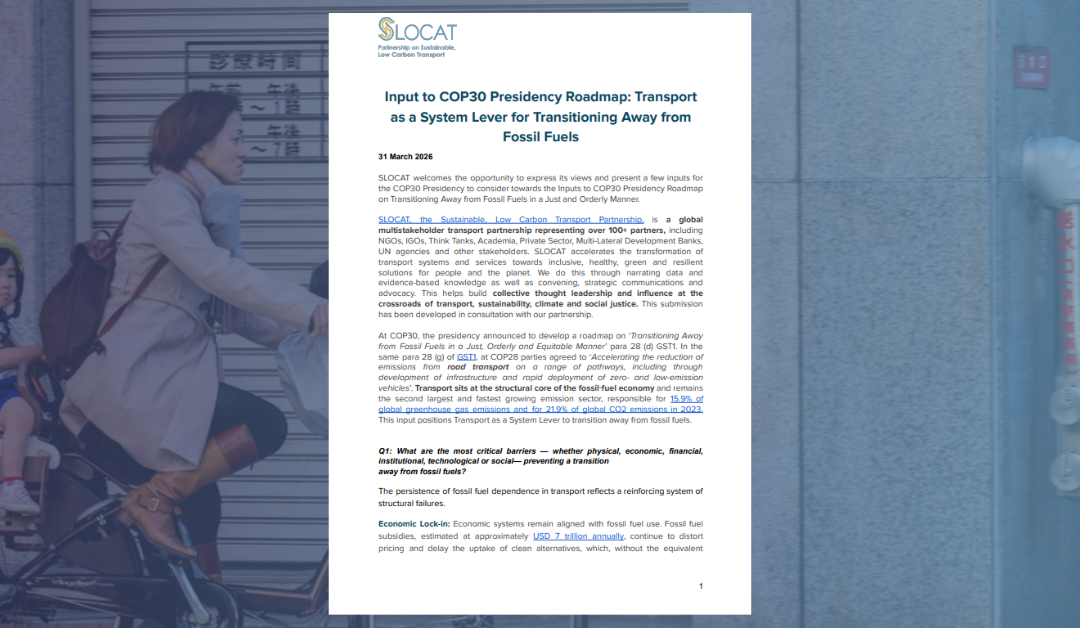
SLOCAT's input to the COP30 Presidency roadmap argues By acting on transport systems, the transition away from fossil fuels can be accelerated across multiple sectors, simultaneously delivering climate, economic,and social outcomes in parallelThe submission is now...

Transport in the newest NDCs, region by region

Transport in the newest NDCs, region by region

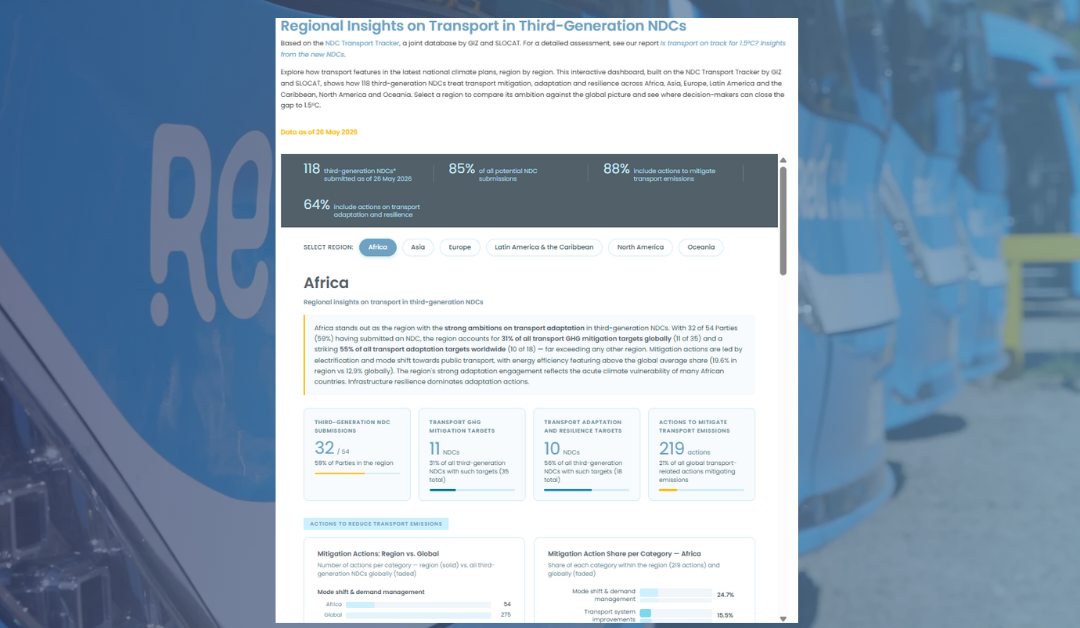
Climate ambition is pledged nationally. But transport gets decarbonised in places: in a Pacific port, on a freight corridor between two Asian cities, along a flood-prone road in West Africa. That is why SLOCAT is sharpening its regional focus. Impact does not come...