The Global Sustainable Logistics Survey launches in 2026 to track progress on decarbonising freight and supply chains over the next decade. Here is what it means for the transport community, and how you can contribute.
Freight transport underpins the global economy. It moves the food on our tables, the materials in our buildings, and the goods on our shelves. Yet when it comes to sustainability, the sector remains remarkably under-studied. We know how many cars are on the road and how fast passenger aviation is growing, but where does global logistics actually stand on its path to a climate-compatible future?
That is the question the Global Sustainable Logistics Survey (GSLS) sets out to answer. Led by the Kuehne Climate Center (KCC) and Kuehne Logistics University (KLU), with the support of a growing network of partners including SLOCAT, the survey is being launched around Smart Freight Week in April 2026 and aims to collect responses from ndustry experts across 43 countries and 10 languages.
Why this survey matters now
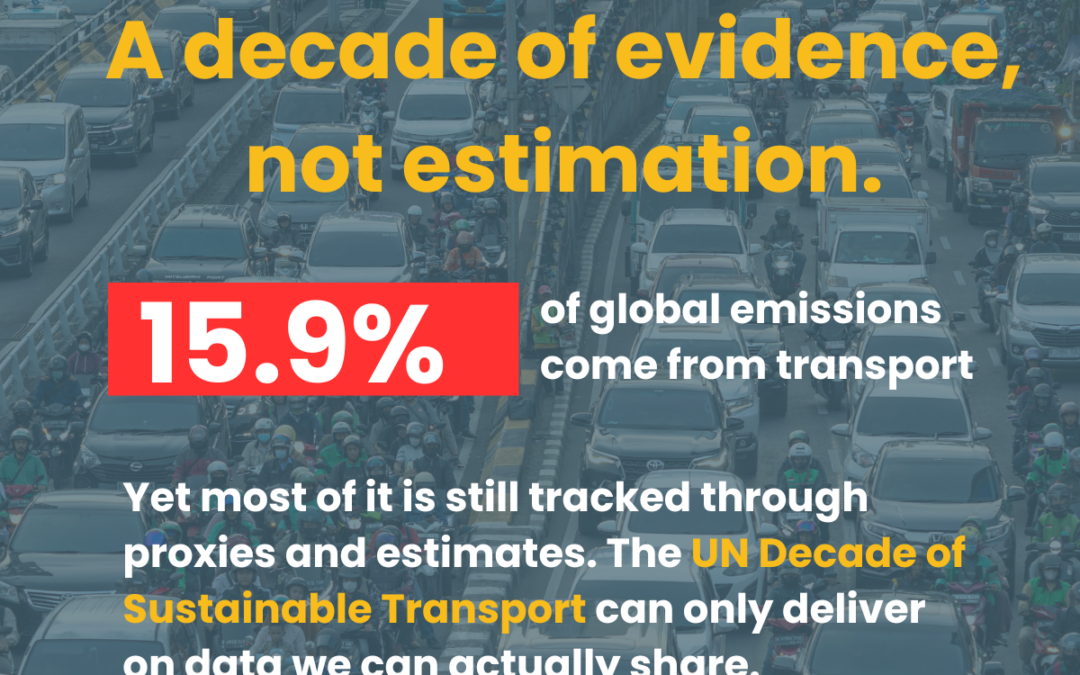
The UN Decade of Action on Sustainable Transport (2026–2035) was launched in November 2025. It calls on stakeholders worldwide to step up commitments and track progress toward sustainable transport systems. But for the freight and logistics sector, no systematic mechanism exists to take stock of where the industry stands or where it is heading.
The GSLS fills that gap. Designed as an annual initiative, it will create an independent, comparable baseline for measuring logistics sustainability over the next ten years. Unlike existing surveys that tend to focus on company-level reporting or country-level performance rankings, the GSLS captures individual expert perspectives on operational realities: what solutions are being adopted, what skills are missing, what barriers persist, and how prepared the sector is for climate impacts.
What the survey covers
The 2026 edition focuses on three interconnected pillars. First, sustainability solutions: from low-carbon technologies to supply chain instruments and market mechanisms, the survey maps what is available, what is being used, and what is holding back adoption. Second, skills and capacity: the green transition requires new technical, analytical, and interpersonal competencies, and the survey will identify where the workforce is ready and where critical gaps remain. Third, adaptation and preparedness: with climate disruptions already affecting supply chains worldwide, the survey assesses how the sector is planning for and responding to physical climate risks.
This combination of themes makes the GSLS unique. It goes beyond carbon accounting to explore the human, institutional, and operational dimensions of logistics decarbonisation.
Who should participate
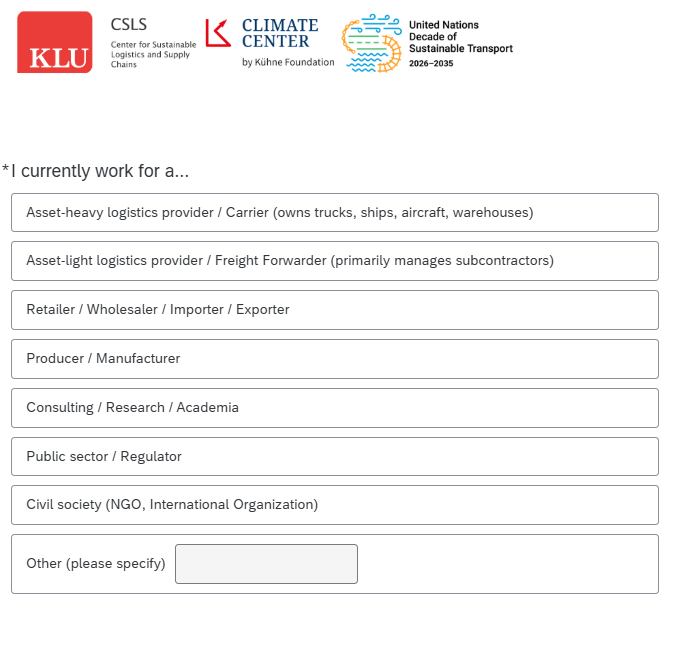
The survey targets senior logistics decision-makers on both the supply side (logistics service providers) and the demand side (manufacturing and retail shippers). If you work in freight, logistics, or supply chain management and have insight into sustainability practices in your organisation or region, your perspective matters.
The research team is also building a global network of ambassadors: experienced professionals who commit to sharing the survey within their networks. Around 50 ambassadors are already on board, each reaching their networks to gather inputs and answers. Professional associations, industry platforms, and transport organisations are also invited to distribute the survey among their members.
What makes it different
The landscape of sustainability surveys is growing, but the GSLS occupies a distinct space. It draws on individual expert perspectives rather than corporate or government data. It concentrates on logistics and transport specifically, rather than the full supply chain. It is global in scope and sector-agnostic. It examines both the solutions in play and the barriers preventing their scale-up. And it officially accompanies the UN Decade of Sustainable Transport, giving it a policy-relevant mandate that extends through 2035.
Importantly, survey data will be made publicly available for research purposes, and a Power BI tool is planned to enable direct benchmarking. The research team at KLU has committed to producing academic studies from the data, ensuring that the findings feed back into the broader knowledge base on transport decarbonisation.
How to get involved
The survey launched during Smart Freight Week in April 2026, with data collection running through June/July 2026 and a first report expected in Q3 2026.
There are several ways to contribute:
- Take the survey once it goes live and share your operational experience and insights.
- Share it within your network to help the project reach the global coverage it needs, particularly in underrepresented regions across Asia, Africa, and Latin America.
- Become an ambassador and formally commit to promoting the survey within your professional community.
- Partner as an association to distribute the survey among your members and, where relevant, host events to discuss the findings.
The decarbonisation of freight and logistics will not happen without better data, clearer baselines, and stronger collaboration between regions and sectors. The Global Sustainable Logistics Survey is designed to support exactly that. As a SLOCAT partner, the Kuehne Climate Center and Kuehne Logistics University are building the infrastructure for a decade of evidence-based action on sustainable logistics.
We encourage the entire transport community to engage with this effort.
For more information or to express interest, contact:
- Laura Huerfano, Survey Project Manager, KLU: laura.huerfano@klu.org
- Prof. Dr. Johannes Meuer, Associate Professor, KLU: Johannes.Meuer@klu.org
- Mark Major, Senior Strategy Director, KCC: mark.major@kuehne-foundation.org