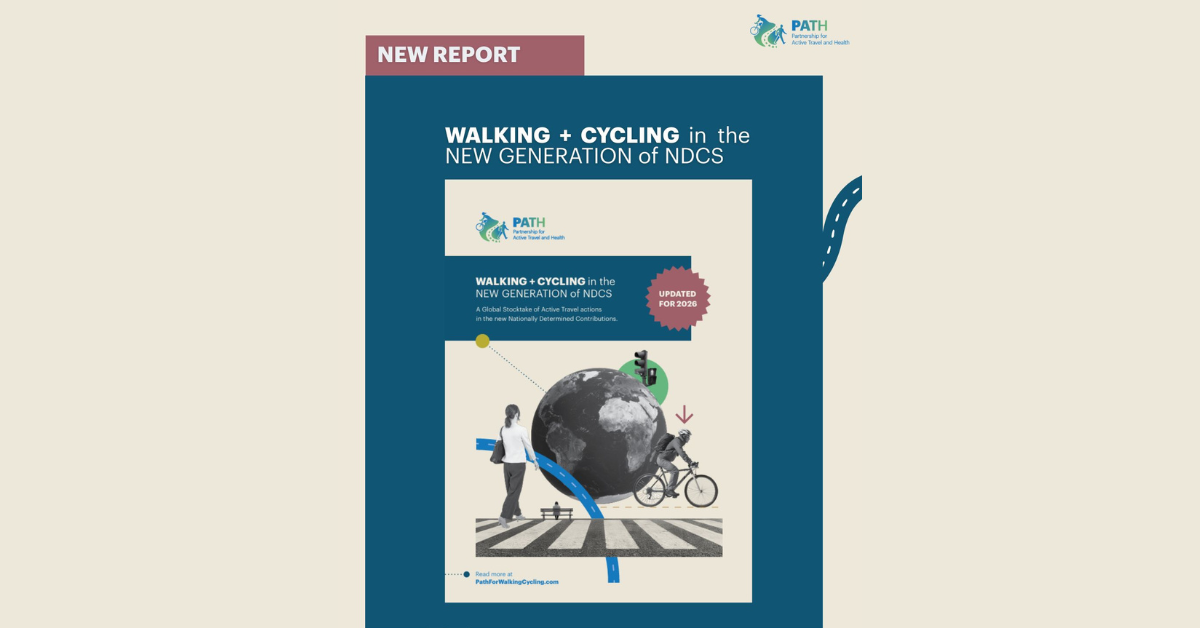
A new analysis from PATH reveals how walking and cycling are finally getting recognition in Nationally Determined Contributions (NDCs), though accountability frameworks still lag behind
Walking and cycling are no longer afterthoughts in the global climate conversation. A comprehensive new analysis from The Partnership for Active Travel and Health (PATH)—of which SLOCAT is a proud partner alongside Walk21 Foundation, European Cyclists’ Federation, FIA Foundation, and UN Environment Programme—reveals that active mobility is gaining significant traction in NDCs. Yet this progress comes with important caveats.
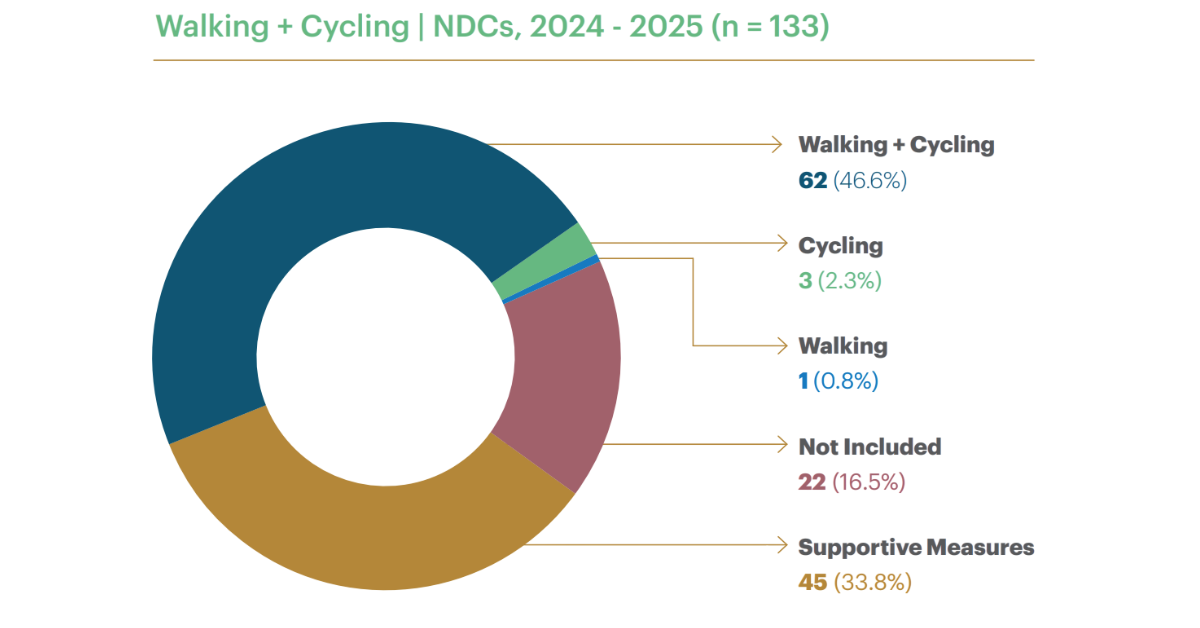
The updated report, Walking + Cycling in the New Generation of NDCs, analyzes 133 newly submitted NDCs covering 67% of global emissions, tracking how countries are integrating walking and cycling from basic recognition to funded, actionable commitments.
The Progress: Active Mobility Enters the Mainstream
Half of newly submitted NDCs (66 of 133) now include walking and cycling as climate solutions—a 12% increase in global coverage since PATH’s 2023 baseline. More than 40 countries have responded to PATH’s advocacy by embedding active mobility into their climate pledges as quick, affordable, and reliable solutions.
Perhaps most encouraging is the financial commitment. Ninety percent of walking and cycling-inclusive NDCs include a visible budget, indicating countries are moving beyond rhetoric toward resource allocation. Countries are listing 54 specific actions supporting active mobility, nearly all reflecting PATH’s Active Mobility policy template recommendations.
Some countries stand out for ambition. Cambodia has developed a comprehensive walking-focused package emphasizing priority networks, connectivity, infrastructure, design standards, and equity. Canada commits CAD $3 billion annually starting in 2026-27 for active transportation. Colombia has set a quantified target: a 5.5% increase in active mobility’s modal share by 2030.
“More than a third of countries are now committed to walking and cycling actions in their NDC, with half of the 133 new policies reflecting many recommendations from the PATH NDC Active Mobility policy template,” notes Jim Walker, Director of Walk21 Foundation, part of the core team atf PATH. “This represents a 12% increase since 2023. The main focus is on physical infrastructure for creating more walkable and cyclable places—a strong foundation that becomes most effective when supported by actions that engage people and embed walking and cycling into policy processes. Since 2023, it’s good to see more countries committing money, but the almost universal lack of credible evaluation frameworks risks the full impact of investment being under-valued.”
However, Jim Walker cautions about a troubling trend: “On a less positive note, 12 countries appear to be reducing their active travel commitments in their new policies despite the agreement that NDCs are designed to be ‘ratchet mechanisms’—progressively more ambitious over time. Although it’s a relatively small number of countries, the collective impact threatens the future active mobility of a quarter of the world’s population.”

The Challenge: Walking Remains Invisible in Accountability
Despite progress, the report exposes a glaring accountability gap. While 65% of walking and cycling-inclusive NDCs commit to general reporting and 30% include formal evaluation frameworks, specific indicators remain rare. Only three countries—Colombia, Lesotho, and Kyrgyzstan—have set measurable cycling indicators.
Walking fares worse: Not a single NDC includes walking-specific indicators, rendering this mode essentially invisible in climate accountability despite its ubiquity and foundational role in multimodal journeys.
The Regression: A Troubling Backward Pedal
Most concerning: 12 countries have removed walking and/or cycling commitments from their new NDCs despite the Paris Agreement principle that NDCs should become “progressively more ambitious.” These countries—including China, Costa Rica, and Sri Lanka—are moving backward despite mounting evidence of active mobility’s climate and co-benefits.
This regression occurs against a shifting global political landscape, including the U.S. withdrawal from the UNFCCC process in January 2026, removing significant commitments included in the previous US administration’s NDC.
The Opportunity: 61 Countries Yet to Submit
Critically, 31% of countries (61 nations as of 8th January 2026) have not yet submitted new NDCs. This represents a timely window to embed walking and cycling into upcoming climate commitments. Countries including India, Egypt, Argentina, and Vietnam can join the growing coalition recognizing active mobility as a cornerstone of climate action.
Where walking and cycling are included, they’re often linked to broader sustainable development outcomes. While Climate Action (SDG 13) and Affordable and Clean Energy (SDG 7) are most referenced, NDCs also commonly cite Sustainable Cities and Communities (SDG 11), Gender Equality (SDG 5), and Clean Water and Sanitation (SDG 6)—demonstrating active mobility’s potential to deliver on multiple development priorities.
Beyond Infrastructure: A Systemic Approach
The report reveals that while 76% of walking actions and 66% of cycling actions focus on creating safe places, other critical dimensions receive less attention. Only 13% of walking actions and 20% of cycling actions focus on supporting and encouraging people to use active modes. Most underdeveloped is the “Process” dimension, governance, regulatory, and financial frameworks, accounting for just 10% of walking actions and 14% of cycling actions.
This imbalance points to an incomplete approach. Infrastructure alone cannot deliver transformation without complementary measures that change behavior, ensure safety, and embed active mobility into institutional processes.
Notably, while 95% of NDCs reference climate policy and 80% mention transport, only 39% explicitly connect to gender policies despite women’s disproportionate reliance on walking. Road safety receives even less attention, mentioned in only 5% of NDCs, despite being a prerequisite for modal shift.
A Call for Coordinated Action
According to IPCC projections, transport emissions must drop by at least 59% by 2050 to limit warming to 1.5°C. In 2023, transport remained the second-largest and fastest-growing emitting sector, responsible for 15.9% of global greenhouse gas emissions, with fossil fuels accounting for 95.4% of transport energy use.
Walking and cycling offer immediate, accessible solutions delivering climate mitigation alongside health, equity, and development co-benefits. They require minimal infrastructure investment, provide universal access regardless of income, and contribute to vibrant, liveable communities.
As countries finalize NDCs and begin implementation, the priority must be threefold: maintaining and expanding commitments to active mobility, developing credible indicators and evaluation frameworks, and ensuring infrastructure investments are complemented by enabling policies and behavioral measures.
Sheila Watson, Deputy Director of the FIA Foundation said: “For a global transport community seeking to accelerate decarbonization while advancing equity and health, walking and cycling are not peripheral solution, they are fundamental. The question is whether we will seize this moment to embed them properly in our climate commitments, or watch hard-won progress slip away.
Read the full PATH report: Walking + Cycling in the New Generation of NDCs
About PATH: The Partnership for Active Travel and Health is a coalition of over 400 organizations coordinated by Walk21 Foundation, European Cyclists’ Federation, FIA Foundation, and UN Environment Programme, working to promote walking and cycling as solutions to climate, health, and equity challenges.