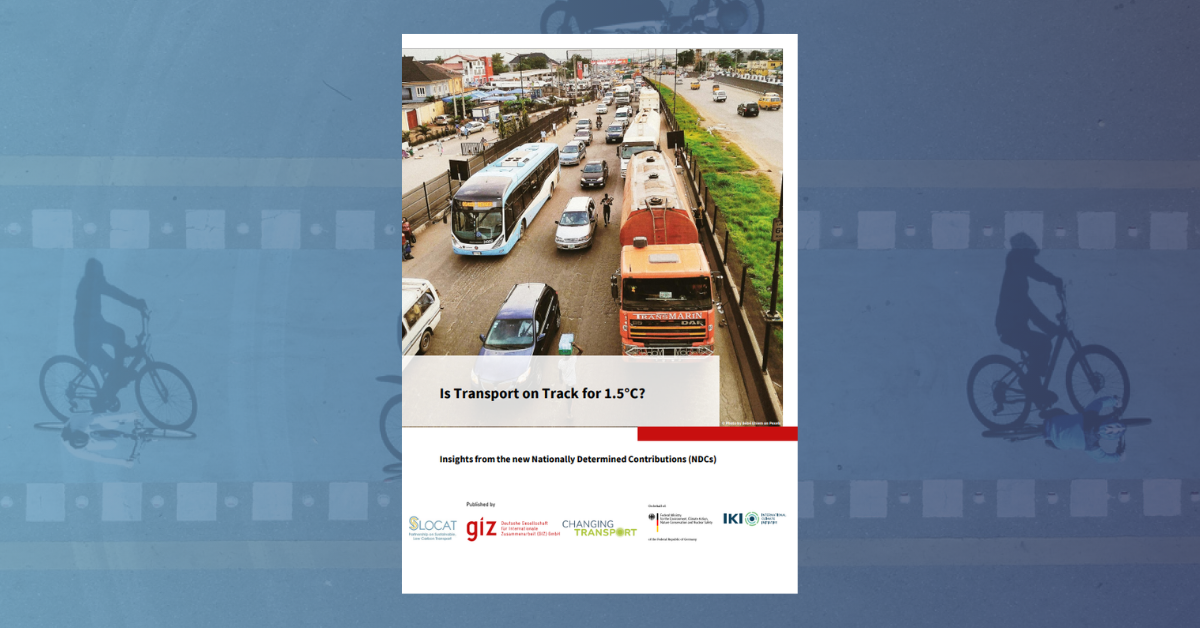
A new SLOCAT–GIZ analysis of 110 new NDCs finds that governments are overwhelmingly backing technology-led solutions while neglecting the systemic changes needed to put transport on a 1.5°C pathway
Transport is the fastest-growing source of greenhouse gas emissions globally, responsible for 15.9% of all emissions in 2024 and still 95.4% dependent on fossil fuels. The third generation of Nationally Determined Contributions (NDCs), the climate pledges countries submit under the Paris Agreement, offered a critical window for governments to course-correct. Our latest report with GIZ, Is Transport on Track for 1.5°C? Insights from the new Nationally Determined Contributions (NDCs), assesses whether they seized it.
The short answer: not enough. While attention to transport in NDCs is growing, current commitments would put the world on track for 2.3–2.5°C of warming, far beyond the Paris Agreement’s goals. And one of the clearest reasons for this gap lies in how countries are planning to decarbonise their transport systems.
According to Daniel Bongardt, Head of ‘Team Infrastructure and Mobility at GIZ’: “The NDC Transport Tracker turns climate commitments into actionable insight. By tracking progress against previous climate plans, it reveals countries’ priorities, strengthens transparency on planned actions, and helps identify opportunities for peer-to-peer learning and targeted capacity-building support.”
The Improve Reflex: Technology Is Dominating the Conversation
Using the NDC Transport Tracker, a database and analytical framework developed jointly by SLOCAT and GIZ, we identified over 1,200 transport climate actions across 110 third-generation NDCs submitted by January 2026.
The picture is striking. When transport actions are classified through the Avoid–Shift–Improve framework, 65% of all mitigation actions fall under “Improve,” focused on less emitting vehicles, alternative fuels and greater energy efficiency. “Shift”, focusing a shift to more environmentally friendly transport modes, accounts for 27%, and “Avoid”, reducing the need for motorised trips altogether, sits at just 8%.
This imbalance has deepened since the previous NDC generation, when “Improve” stood at 60%. E-mobility is now referenced in 78% of third-generation NDCs, making it the single most popular action area. One in four transport actions globally is about electrification. Zero-emission vehicle targets represent 41% of all non-GHG transport targets.
The growth of e-mobility ambition is, in many respects, welcome. The fossil fuel dependency in transport needs to be reduced by moving away from combustion engines. The global electric vehicle fleet has expanded from around 730,000 battery-electric cars in 2015 to more than 39 million in 2024. Enormous uptakes are being recorded for electric two- and three-wheelers as well as buses. Countries are responding to a real technological shift. But the risk is clear: when electrification dominates the policy landscape, other essential strategies get crowded out.
The Missing Pillars: Public Transport, Walking and Cycling
Public transport, walking and cycling represent the backbone of sustainable, low-carbon mobility, particularly in urban areas, where the majority of transport emissions are produced. Public transport, combined with active mobility and vehicle efficiency improvements, could reduce urban passenger transport emissions by around a third compared to business-as-usual. People who cycle daily emit 84% fewer transport-related greenhouse gases than those who do not.
Yet the latest NDCs tell a different story. Public transport actions have actually declined compared to the previous NDC generation, from 131 actions in second-generation NDCs (submissions from 2019 to 2024) to 112 in the current generation. References to bus rapid transit have fallen sharply, from 19 NDCs to just 8. Active mobility features in only 28% of third-generation NDCs, and many of those references remain vague, mentioning “promotion of active transport” without concrete infrastructure targets or investment commitments.
And while mode share targets were the second most common type of non-GHG target in first-generation NDCs (28%), their share has dropped to just 12%, overtaken by the surge in zero-emission vehicle targets.
57 actions focus on electrifying bus fleets in the current NDCs, reflecting twice as many as in the previous generation. This is one example of how “Improve” and “Shift” can reinforce each other. But when NDCs lean overwhelmingly towards one pillar, the systemic transformation that transport requires is unlikely to materialise.
Blind Spots That Cannot Be Ignored
The technology bias also masks significant gaps across transport modes and segments. Freight transport, responsible for 43% of transport CO₂ emissions, appears in mitigation actions in only 41% of NDCs. Informal transport, which provides essential mobility for hundreds of millions across the Global South, remains largely invisible. Aviation and shipping, despite accounting for nearly a quarter of transport emissions combined, are addressed by only a minority of submissions and rarely connected to international commitments under ICAO and IMO.
These blind spots matter. Future growth in transport emissions will be concentrated in low- and middle-income countries, where capacity constraints, financing gaps and transport demand are most acute. Without addressing freight, informal services and long-distance modes, the NDC framework will continue to undercount the real scale of the challenge.
What Needs to Change
The report identifies several priorities for strengthening transport in future climate commitments:
- Countries need to set clearer, longer-term emission reduction targets for the transport sector, and connect these to long-term low-emission development strategies.
- They need to rebalance the Avoid–Shift–Improve equation, investing in demand reduction and mode shift alongside vehicle technology.
- Underrepresented transport segments, from freight to walking and cycling, need dedicated targets, actions and finance.
- Climate adaptation for transport, still treated as a secondary concern despite mounting evidence of climate-related damage, must be integrated into every NDC.
Carly Gilbert-Patrick, Secretary General of SLOCAT, on what needs to be done: “This new report delivers a comprehensive analysis of transport in NDCs and sends a clear and urgent message: we can not meet global climate goals without decarbonising the transport sector and while transport is receiving unprecedented attention in climate action plans, ambition levels still fall short of what’s needed. We have the solutions and tools at our fingertips and now need to see the scale of implementation. SLOCAT calls on all stakeholders to treat this as a wake-up call. We must dramatically accelerate our efforts to decarbonise transport, leveraging the sector’s enormous potential to mitigate climate change through bold and swift action.”
The declaration “Towards Resilient and Low-Emissions Transport Systems for People, Development and the Planet”, launched by Chile and endorsed by 11 countries at COP30, offers an encouraging signal: a shared commitment to cutting transport energy demand by 25% by 2035, with one-third of energy supplied from renewable sources. The Global Implementation Accelerator and the Belém Mission to 1.5°C, led by the Brazil COP30 and Australia COP31 Presidencies, provide platforms for turning ambition into action.
But these initiatives will only deliver if countries move beyond the comfort zone of technology-first approaches and embrace the harder, more transformative work of reshaping how people and goods move. Ultimately, countries have to commit to transition away from fossil fuels and pursue deep decarbonisations.
This report was published by SLOCAT and GIZ as part of the Mobilize Net-Zero project, funded by the International Climate Initiative (IKI) of the German Federal Ministry for the Environment, Climate Action, Nature Conservation and Nuclear Safety (BMUKN).