The cycling community set out its contribution for economic growth in Europe
Brussels, 4th December 2014
“We can create more jobs for Europeans through investment in cycling, not only because it has a proven record for creation of green and sustainable jobs, but because of the huge contributions it makes to the EU’s wider objectives. Our partners, our businesses and policy makers are ready to building on cycling’s current 650,000 jobs and €217billion per year contribution to the EU economy”, said Kevin Mayne, ECF Director of Development.

There are three focus points for ECF, which correspond to three new publications:
– We need more investments in cycling by providing EU subsidies for cycling measures
– We need to integrate cycling into growth plans
-We need to provide fiscal benefits for cyclists
Cycling boosts jobs and growth
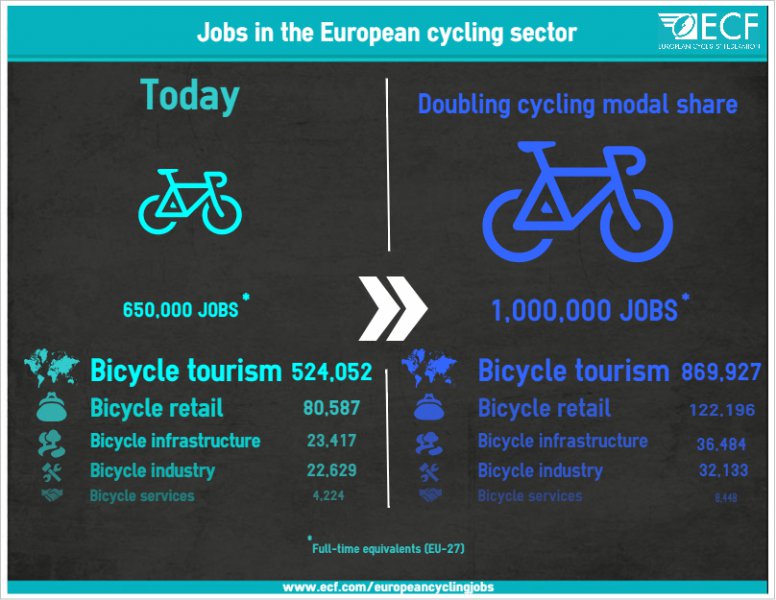
According to ECF’s report “Jobs and job creation in the European cycling sector”, there are more than 650,000 full-time jobs linked to cycling today in Europe. This number is estimated to increase up to 1 million jobs by 2020 if cycling modal share doubles, as ECF vision supports.
In terms of investments, many member states and the European Union have protected funding streams for job creation. So this study is a resource to help supporters of cycling seek funding in those areas too.
Policies and resources for cycling investment
To facilitate national and regional governments ECF put together the most effective tax and promotional incentives in favour of cycling. For the first time ever, ECF provides case studies of 11 European countries, analysing the state of play for mileage allowances, tax allowances and bike purchase schemes in commuting.
In terms of resources, ECF discovered that more than €2 billion euro can be unlocked for cycling from EU subsidies until 2020. This amount is three times bigger than the former financial period. “We should act immediately to take advantage of this opportunity”, said Adam Bodor, ECF Director of Regional Policy. By combining national funds and private capital with European money, member states can benefit from a remarkable return on investment while fulfilling their commitments for clean and sustainable growth.
The timing of presenting Cycling for Growth plan could not be more fitting at the European level as the new EU Commission has announced a €300bn investment plan for reaching the targets on jobs and growth by 2020. Cycling welcomes the Junker investment plan with high hopes. Through these studies, ECF shows that cycling is ready to play an important role in the future of Europe and we are going to use them to argue that cycling should get part of this investment too.
ENDS
Notes to the Editor
Read here the full electronic version of the new ECF reports:
Jobs and job creation in the European cycling sector
Commuting: Who pays the bill?
Cycling for Growth: Using European funds for cycling
Royalty-free images and info-graphics are available in our Flickr album:http://goo.gl/1P8Lvw
About the European Cyclists’ Federation (ECF)
www.ecf.com
With over 80 members across nearly 40 countries, the European Cyclists’ Federation (ECF) unites cyclists’ associations from across the globe, giving them a voice on the international level. Our aim is to get more people cycling more often by influencing policy in favour of cycling.
For more information:
Elina Baltatzi, ECF Communication Officer
Email: e.baltatzi@ecf.com
Tel: +32 2 880 92 74
Mob: +32 49 4247220