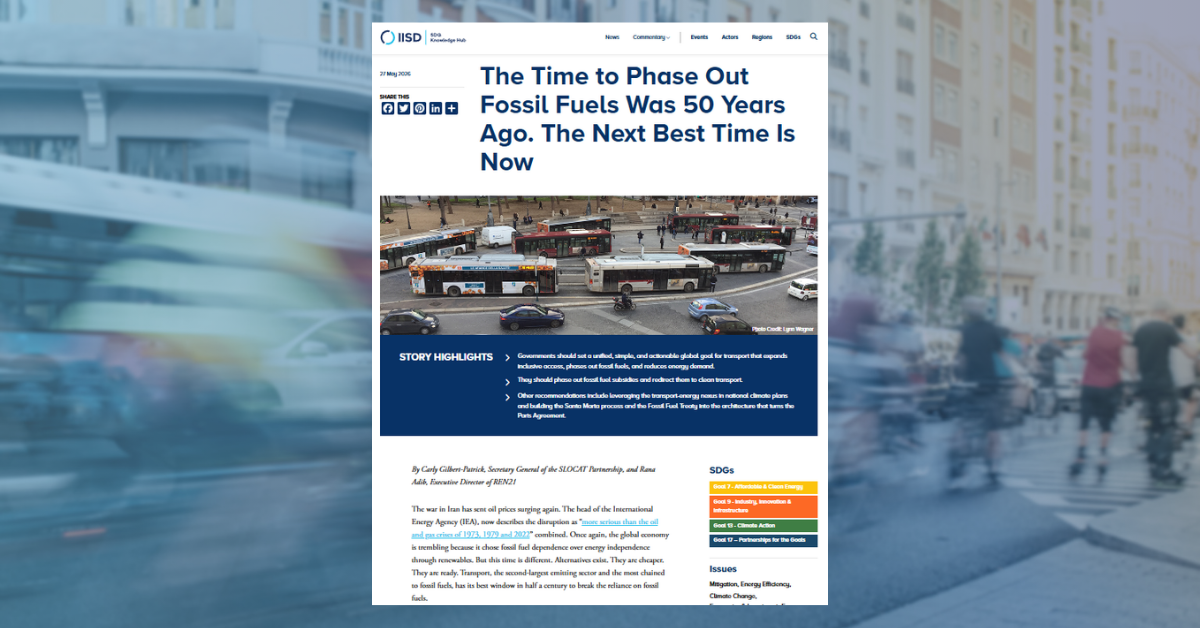
SLOCAT’s input to the COP30 Presidency roadmap argues By acting on transport systems, the transition away from fossil fuels can be accelerated across multiple sectors, simultaneously delivering climate, economic,and social outcomes in parallelThe submission is now public, and it arrives just as governments prepare to meet in New York for HLPF 2026.
Transport accounts for almost 90 percent of global oil demand, and fossil fuels still supply 95.4 percent of the energy it runs on, a share that has barely shifted in five decades.
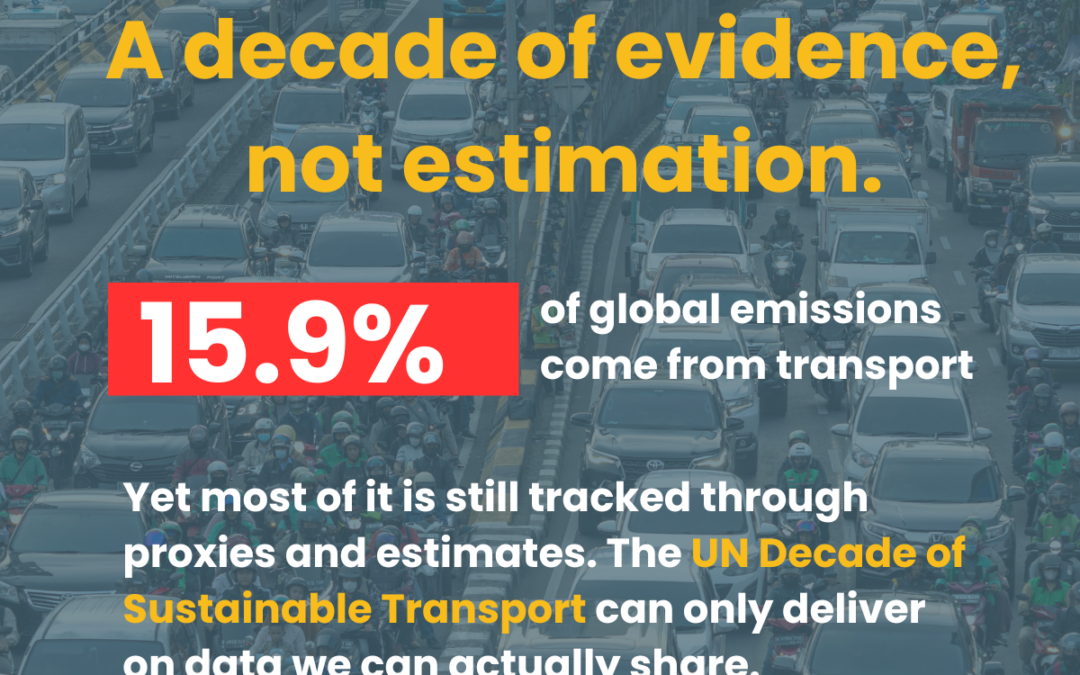
Transport is also the second largest and fastest-growing source of emissions, responsible for 15.9 percent of global greenhouse gas emissions in 2023.
That reframes the entire conversation about phasing out fossil fuels.Transport drives fossil fuel demand but also reinforces to through nexus with other sectors. At the same time, sustainable transport is catalyst- a lever, to accelerate decarbonisation in other sectors. This is the core argument of SLOCAT’s submission to the COP30 Presidency’s roadmap on Transitioning Away from Fossil Fuels in a Just, Orderly and Equitable Manner, now published on the UNFCCC website as one of roughly 267 inputs received.
Three levers that break the lock-ins
Because transport is wired into energy, land use, trade and industry, acting on it cascades across the economy. The submission prioritises a small set of system-level levers rather than a wishlist.
A quantified global goal for transport to align policy, finance and implementation, and to send a clear investment, political implementation signal. A fossil-free policy and investment mandate that redirects public budgets and development bank portfolios away from highway expansion and toward people-centred access. And a real-time monitoring platform, built on the Transport Data Commons, that tracks subsidies, emissions and finance and feeds into UNFCCC reporting cycles.
The most persuasive number sits inside the second lever. Avoid and Shift strategies can deliver 40 to 60 percent of the transport emission reductions needed, yet they receive only 8 and 27 percent of the national plan transport actions, respectively. Reorienting the roughly USD 7 trillion spent each year on fossil fuel subsidies toward the USD 2.7 trillion clean transport funding gap is the most cost-effective near-term move available.
None of this works if equity is a footnote. Around 193 million transport workers face disruption and need reskilling and social protection, and informal transport has to be integrated rather than displaced. Equity is a precondition for implementation, not an add-on.
SLOCAT proposes clear sequence of action for phasing out of fossil fuels, starting with stopping the new fossil lock in, shifting financial flows, Embedding demnad reduction, followed by adopting a quantified global goal for transport, establishing accountability systems and leveraging UNFCCC and SDGs processes, to further guide the phasing out of fossil fuels.
Why this matters in New York this July
As we publish this, governments are heading to the UN High-Level Political Forum in New York from 7 to 15 July. This year’s in-depth reviews include SDG 11 on sustainable cities and SDG 7 on energy. Both run straight through transport.
You cannot deliver sustainable cities without rethinking urban mobility, and you cannot talk about clean energy while the sector burning a quarter of the world’s end-use energy, stays 95 percent fossil-fuelled for five decades. The HLPF theme this year calls for transformative, equitable and coordinated action. That is exactly the logic our submission applies to transport.
What happens next
The COP30 Presidency will now develop a version of the roadmap, drawing on the inputs received, to present during or ahead of COP31. Our message is straightforward: treat transport not as a standalone sector but as a system lever that catalyses the move away from fossil fuels. Partial or delayed interventions will only harden the lock-ins we already have